Evidence #565 | November 12, 2026
Book of Abraham Evidence: The Angel of the Lord (Fac. 1, Fig. 1)
Post contributed by
Scripture Central
Abstract
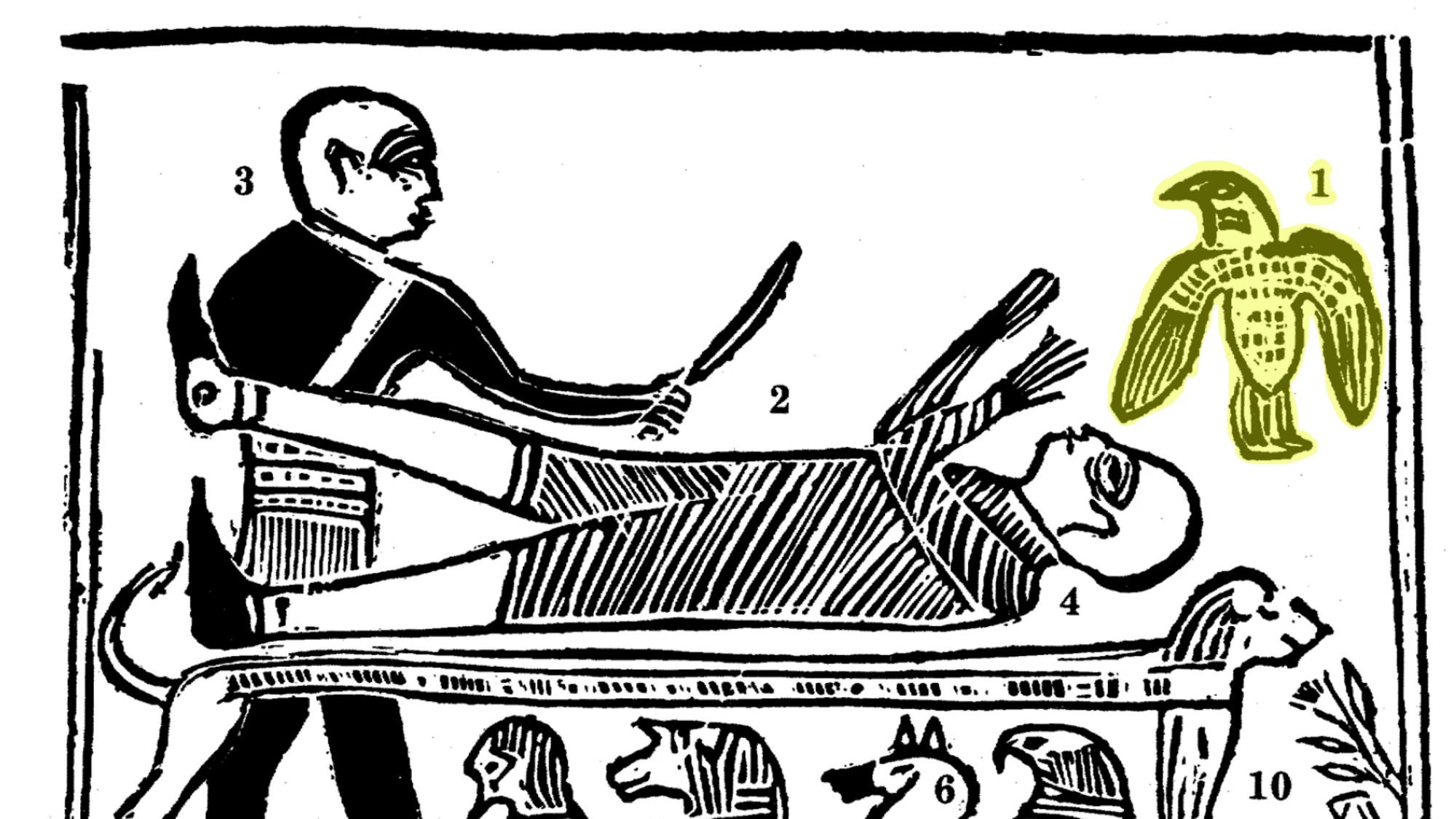
Facsimile 1, Figure1 is explained in the Book of Abraham as the “Angel of the Lord.” The ancient Egyptians viewed this figure as a ba-bird, which can indeed function as an angel or divine messenger in certain settings of their culture.Within the Book of Abraham, Figure 1 of Facsimile 1 appears to depict the body of a hawk or falcon and is located in the upper-right register of the vignette.1 In its original 1842 publication, the figure clearly has the head of a bird. However, because this portion of the papyrus was missing in Joseph Smith’s day, the head had to be reconstructed. Although some lion-couch scenes similar to Facsimile 1 feature hovering birds with typical avian heads, most depict birds with human heads. This has led some to conclude that the bird in Figure 1 likely had a human head.2 Whatever its complete form may have been, the explanation provided for this figure is “The Angel of the Lord.”3

Narrow Egyptological Interpretations
Over the years, a number of non-LDS scholars have offered varying interpretations of Figure 1. Some of these were published in 1912 by Franklin S. Spalding, who corresponded with several prominent Egyptologists of that time and compiled their assessments of the Book of Abraham facsimiles.4 Among the responses, Flinders Petrie identified the bird in Figure 1 as the “hawk of Horus.”5 James H. Breasted explained Figure 1 as “a bird, in which form Isis is represented.”6 According to John Peters, “at the head” of the deceased body, “the soul (Kos) is flying away in the form of a bird.”7 Edward Meyer described it as “the soul in the shape of a bird flying above” the “body of the dead.”8 Along the same lines, Friedrich von Bissing explained, “The soul is leaving the body in the moment when the priest is opening the body with a knife for mummification.”9
In 1968, Richard Parker described the bird of Figure 1 as “Nephthys, sister to Osiris and Isis.”10 In the same year, Klaus Baer, under the assumption that the original bird indeed featured a human head, interpreted it specifically as the “ba [i.e., spirit] of Osiris … hovering above his head”.11 Robert Ritner’s explanation in the year 2000 is quite similar: “the human-headed ba-spirit of [Osiris] Hor hovers above his head.”12 Despite some differences in identification, these later interpretations echo earlier proposals that associate the bird with the spirit of the deceased or with divine figures connected to Osiris.
A Broader Interpretive Context
Because of their Egyptian origin, it has often been assumed that the facsimiles of the Book of Abraham should be exclusively interpreted from an ancient Egyptian perspective. Many Latter-day Saint scholars, on the other hand, have viewed their interpretation as a much more open-ended question, leaving room for both Egyptian and Semitic explanations from various time periods, as well as the possibility of ancient or modern syncretization.13
With these broader interpretive frameworks in mind, it is important to recognize that Joseph Smith’s explanations relate first and foremost to the text of the Book of Abraham itself. His primary purpose was not to restore ancient Egyptian religion. Figure 1 (“The Angel of the Lord”) corresponds to a moment in the text of the Book of Abraham itself, as narrated in the first-person by Abraham: “the priests lifted up their hands upon me, that they might offer me up and take away my life, behold, I lifted up my voice unto the Lord my God, and the Lord hearkened and heard, and he filled me with the vision of the Almighty, and the angel of his presence stood by me, and immediately unloosed my bands” (Abraham 1:15).
In an ancient Jewish context, the phrase “angel of his presence” essentially meant “messenger of his face”—signifying that the messenger is a representative or manifestation of the deity himself.14 In Abraham’s account, the “angel of his presence” announces that he is (or, at least, represents) none other than Jehovah: “my name is Jehovah, and I have heard thee, and have come down to deliver thee …. Behold, I will lead thee by my hand, and I will take thee, to put upon thee my name, even the Priesthood of thy father, and my power shall be over thee” (Abraham 1:16–18).15
Within Latter-day Saint theology, such terminology resonates with the purpose of the temple endowment, which prepares individuals to overcome the effects of the Fall through Christ’s redeeming power and ultimately return to God’s presence in glory.16 Viewed in this light, Abraham’s rescue from sacrifical death by the “angel of his presence” may typologically anticipate Jehovah’s triumph over death and hell, through which humanity is freed from the bonds of death and enabled to receive eternal life.17
This expanded contextual understanding of Figure 1 invites a closer examination of its various meanings in ancient Egyptian settings. The first thing to consider is the remarkable flexibility of avian symbolism in Egyptian thought. Through the convention of fictional dialogue, Nibley explains the following concerning a human-headed hawk at Opet: “The hawk can be Osiris as well as his father, his mother, and his son! The whole amazing operation takes place on the lion couch, and to put over the whole message, a variety of birds is necessary. It is as silly to think that a bird can have only one significance as to think the same of a lion couch.”18
This interpretive flexibility is reinforced by Lloyd Graham’s much more recent study of birds hovering above Osiris in scenes associated with his regeneration, which share some common elements with Facsimile 1. Tracing the changing depictions and identifications of these avian images from the Thirteenth Dynasty through the Greco-Roman period, Graham concludes that “pluralistic interpretations—in the case of such scenes, the ability to identify the same bird as an Isis-kite, a Nekhbet-vulture and a Horus-falcon—are very much in keeping with the Egyptians’ penchant for flexible ‘both/and’ thinking and their well-known ability to entertain multiple parallel truths.”19
Importantly, Nibley has demonstrated that divine messengers in ancient Egyptian texts are indeed sometimes associated with the hawk or falcon, often representing the ba or spirit of a deity.20 The term “angel” would not be inappropriate in this context. As noted by John Gee, “Most Egyptologists think that Figure 1 should have a human head, which would make it a ba-bird, a term which ancient Egyptians translated into Greek as angelos, or angel.”21
In this regard, an ancient dialogue recorded in Coffin Text 312 may be significant. The scene opens with the god Osiris, representing the deceased person, in a state of weariness and vulnerability, pleading to Horus for help to escape the gates of the Netherworld. Horus then sends a messenger, identified as a ba-spirit, who specifically takes the form of a divine hawk or falcon.22 As explained by Nibley, “The leading character is the messenger-bird, who is dressed as a hawk in imitation of Horus.”23 Nibley then draws out a fascinating connection to this scene, in which a figure on a lion couch is specifically concerned about death and execution:
In one of the Coffin Text inscriptions (T1C) the ideogram for the helplessness of the god shows him on the lion couch; that this is more than a meaningless convention is indicated in T. George Allen’s edition of the Book of the Dead, where chapter 85 is headed by a vignette of a figure on a lion couch under the ba-bird with an unerased falcon head and is entitled “Spell for assuming the form of a Soul and not entering the place of execution” (see p. 259, fig. 31). “Dying is my abomination,” says the figure on the lion couch; “I enter not into the execution-place of the Nether World.” Here the lion-couch vignette matches the lion-couch scenes of the temples of Opet, Seti I, Philae, and so forth, as well as the situation in the play.24
In other vignettes, the ba-bird can be seen as the “protector of the corpse” of the deceased.25 The Litany of Re describes “one with the speaking Ba, who is content (united) with his utterance, who protects Spirits-Akhu, the Westerners, so they could breathe through him.”26 Related imagery arises in Coffin Text 312, where the divine falcon (the ba of Horus) declares to the deceased Osiris, “Be high on your seat, O Osiris; may your breast live.”27 Iconography from a tomb in Thebes is also relevant, in which a ba-bird with a human head hovers over a mummy on a lion couch. The bird is depicted as giving life and breath to the deceased, as symbolized by the ankh and sail in the bird’s hands, which are positioned over the mummy’s head.28 Typically, it is gods who offer these symbols to the king or deceased, suggesting that the bird in this context is not the ba of the deceased, but the ba of a god—i.e., the messenger or angel of the god.

Jiri Janak has noted that the “terms ba or bau were used in the Pyramid Texts to denote the power of the gods and the resurrected king, or to describe the gods and the king as ‘powers’. The deceased king was transformed (by the funerary rites and by overcoming death) into a super-human or rather divine entity endowed with great power and might.”29 This recalls the specific promise given to Abraham by the angel of the Lord in Abraham 1:18: “I will take thee, to put upon thee my name, even the Priesthood of thy father, and my power shall be over thee.”
Thus, not only could the ba-bird of Egyptian iconography function as a divine messenger (i.e., an angel) that was imbued with the form and power of the God it represented, but it could also be associated with the protection of the deceased, deliverance from the underworld, and the restoration of life itself. These associations resonate with Joseph Smith’s interpretation of Figure 1, in which the bird represents the heavenly messenger who rescues Abraham from imminent death. Moreover, insofar as Abraham’s deliverance foreshadows Christ’s ultimate victory over death and hell through the Resurrection, the Egyptian funerary imagery provides an illuminating backdrop for the story’s typological significance.
Parallels with the Apocalypse of Abraham
A surprisingly similar scene from the Apocalypse of Abraham becomes quite significant in understanding this broader interpretive framework. Although there are differences between it and the Book of Abraham, they share numerous intriguing parallels.30 Both texts, for instance, describe the idolatrous practices of Abraham’s father and situate his rejection of false worship within a broader context of sacrifice and divine intervention. Moreover, in both narratives, Abraham receives a revelation from a divine messenger who addresses him by name and promises protection or deliverance.
The most relevant correspondence, however, concerns the heavenly messenger’s power over death itself. Abraham reports, according to Abraham 1:15–16, that “the angel of his presence stood by me, and immediately unloosed my bands; And his voice was unto me: Abraham, Abraham, behold, my name is Jehovah, and I have heard thee, and have come down to deliver thee.” In the Apocalypse of Abraham, however, the scope of the angel’s deliverance is considerably broadened. Yahoel identifies himself as one commissioned to restrain “Leviathan” (a monster symbolizing primordial chaos), as well as to “loosen Hades and to destroy those who wondered at the dead.”31
Also of interest is the emphasis in the Apocalypse of Abraham on the angel specifically taking Abraham by the right hand and bringing him into a standing or raised position. “The angel he sent to me in the likeness of a man came, and he took me by my right hand and stood me on my feet. … And I stood up and saw him who had taken my right hand and set me on my feet.”32 Some scholars have connected this imagery to the theme of resurrection.33
Later in this text, Abraham explains that the angel “took me with his right hand and set me on the right wing of the pigeon and he himself sat on the left wing of the turtledove.”34 This curious imagery of Abraham and Yahoel ascending into heaven on the wings of sacrificial birds offers yet another intriguing connection, especially when Yahoel’s own form is considered.35 As observed by Andrei Orlov, scholars have found it “unusual and even puzzling” that Yahoel appears to be depicted as a “pteromorphic creature who possesses the body of a griffin.”36 Whatever explanations might be offered for this imagery, it is fascinating that the Apocalypse of Abraham portrays a bird-like heavenly messenger escorting Abraham (presumably his soul or spirit) into heaven, each on the wings of sacrificial birds. This parallels the conventional Egyptological interpretation of Figure 1, in which the bird represents the ascending ba (or soul) of the figure lying on the altar, whom Joseph Smith identified as Abraham.37
As for the imagery of Abraham’s being raised up by the right hand, it seems to relate to the Day of Atonement ritual, in which the high priest used his right hand in handling the sacrificial offerings, particularly the goat designated for the Lord. Orlov explains,
This peculiar hand laying gesture occurs right before Abraham’s entrance into the celestial Holy of Holies. This further strengthens the possibility that the patriarch is being portrayed as the immolated goat—the crucial sacrificial agent who was consistently handled in the Jewish atoning rite with the high priest’s right hand.38
This interpretation finds a meaningful parallel in Abraham 1, where Abraham is likewise depicted as a sacrifice (albeit of a different type), with particular emphasis on how he is handled. The narrative depicts wicked priests who seek to “offer up” Abraham as a sacrifice and who “lift up” their hands against him. In contrast, Abraham “lifted up” his voice to God, and the angel “stood” by him and took him “by [his] hand” to deliver him from death:
- “Therefore they turned their hearts to the sacrifice of the heathen in offering up their children unto these dumb idols, and hearkened not unto my voice, but endeavored to take away my life by the hand of the priest of Elkenah.” (Abraham 1:7)
- “And as they lifted up their hands upon me, that they might offer me up and take away my life, behold, I lifted up my voice unto the Lord my God, and the Lord hearkened and heard, and he filled me with the vision of the Almighty, and the angel of his presence stood by me, and immediately unloosed my bands;” (Abraham 1:15)39
- “Abraham, Abraham, behold, my name is Jehovah, and I have heard thee, … therefore I have come down to visit them, and to destroy him who hath lifted up his hand against thee, Abraham, my son, to take away thy life.” (Abraham 1:16–17)
- “Behold, I will lead thee by my hand, and I will take thee, to put upon thee my name, even the Priesthood of thy father, and my power shall be over thee.” (Abraham 1:18)
When read alongside the Apocalypse of Abraham, these details reinforce the proposed cosmological interpretation of Abraham’s deliverance. In contrast to the hands of the wicked priests that threaten Abraham, the hand of Jehovah brings about his immediate rescue, symbolically foreshadowing Abraham’s eternal deliverance from death and his eventual exaltation as a resurrected being. In both accounts, the imagery of sacrifice, divine intervention, and being raised or led by the hand evokes themes central to Latter-day Saint temple worship. Abraham’s rescue thus becomes a fitting symbol of Christ’s redemptive atoning sacrifice, through which the bonds of death and hell are broken and the faithful are raised up to eternal life in God’s presence.40
Conclusion
To many Egyptologists, Figure 1 appears to depict the ba or spirit of the deceased Osiris rising from his body in a funerary context. At first glance, this narrow interpretation may seem at odds with the explanation given in the Book of Abraham. Yet Joseph Smith’s revelation never suggests that its explanation of this figure was derived primarily or exclusively from an ancient Egyptian worldview. This leaves open the possibility that the original Egyptian iconography was adapted or reinterpreted to reflect Abraham’s deliverance in Abraham 1, perhaps preserving some of the cosmic elements of its Egyptian symbolism while incorporating additional Semitic and temple-related meanings.41
Several strands of evidence lend plausibility to this broader interpretive framework. Egyptian traditions associated the ba-bird not only with the spirit of the deceased but with divine messengers, the spirit of a god, endowments of supernatural power, the protection of the deceased, deliverance from the underworld, and the restoration of life. These associations resonate with Abraham’s miraculous rescue from imminent death by an angel or messenger of the Lord who identified himself with Jehovah, who promised to endow Abraham with divine power, and whose intervention seems to symbolically anticipate Christ’s ultimate triumph over death and hell. The parallels become even more intriguing when considered alongside the Apocalypse of Abraham, where a divinely empowered birdlike angel raises Abraham by the right hand in a scene evoking the Day of Atonement, escorts him into heaven on the wings of sacrificial birds, and exercises authority over a primordial chaos monster and Hades itself.
As can be seen, Joseph Smith’s explanation of Figure 1 resonates with a rich tapestry of religious imagery and symbolism. The convergence of Egyptian funerary connotations, ancient Abrahamic traditions, and the Book of Abraham’s own typological narrative is quite striking. These mutually reinforcing connections provide meaningful evidence that Joseph Smith’s explanation reflects an authentic ancient religious context, rather than merely a modern reinterpretation of an Egyptian image.
Stephen O. Smoot, John Gee, Kerry Muhlestein, and John S. Thompson, “Facsimile 1 as a Sacrifice Scene,” BYU Studies Quarterly 61, no. 4 (2022): 221–225.
Hugh Nibley, An Approach to the Book of Abraham, The Collected Works of Hugh Nibley, Volume 18 (FARMS and Deseret Book, 2009), 258–287.
Hugh Nibley, The Message of the Joseph Smith Papyri: An Egyptian Endowment, 2nd edition (FARMS, 2005), 112–116.
Hugh Nibley, Abraham in Egypt, 2nd ed., ed. Gary P. Gillum, The Collected Works of Hugh Nibley 14 (FARMS and Deseret Book, 2000), 11–42.
Old Testament
Genesis 12:8
Genesis 13:4
Genesis 15:2
Genesis 15:8
Genesis 21:33
Leviticus 16:5–10
Leviticus 16:15–22
Psalm 116:3
Psalm 116:8
Psalm 116:16
New Testament
Acts 2:24
Book of Mormon
Mosiah 15:20
Alma 7:12
Pearl of Great Price
Abraham 1:7
Abraham 1:15–18
Abraham, Facsimile 1
- 1. See A Facsimile from the Book of Abraham: No. 1.
- 2. See Hugh Nibley, An Approach to the Book of Abraham, The Collected Works of Hugh Nibley, Volume 18 (FARMS and Deseret Book, 2009), 260–261. On page 139, Nibley writes, “The earliest and latest scholarly critics of the facsimiles have insisted that the bird in Facsimile 1 should have a human head. Though the bird’s head, being on the edge of the papyrus, was broken off even before it was mounted, enough of the neck fortunately remains to show that it never bore a human head.” However, in the introduction to this volume, John Gee, the editor, suggests that Nibley may well have been mistaken on this point: “Nibley’s interpretation of the head on figure 1 has not stood the test of time particularly well” (p. xxxv). For an example of a critical opinion contrary to Nibley, see Edward H. Ashment, “The Facsimiles of the Book of Abraham: A Reappraisal,” Sunstone 4, nos. 5–6 (December 1979): 38, 43.
- 3. A Facsimile from the Book of Abraham: No. 1.
- 4. Franklin S. Spalding, Joseph Smith, Jr., as a Translator: An Inquiry (Arrow Press, 1912).
- 5. Spalding, Joseph Smith, Jr., as a Translator: An Inquiry, 23.
- 6. Spalding, Joseph Smith, Jr., as a Translator: An Inquiry, 26.
- 7. Spalding, Joseph Smith, Jr., as a Translator: An Inquiry, 28.
- 8. Spalding, Joseph Smith, Jr., as a Translator: An Inquiry, 30.
- 9. Spalding, Joseph Smith, Jr., as a Translator: An Inquiry, 30.
- 10. Richard A. Parker, “The Joseph Smith Papyri: A Preliminary Report,” Dialogue: A Journal of Mormon Thought 3, no. 2 (1968): 86.
- 11. Klaus Baer, “The Breathing Permit of Hôr: A Translation of the Apparent Source of the Book of Abraham,” Dialogue: A Journal of Mormon Thought 3, no. 3 (1968): 118. Note that Baer initially saw the bird as a standard falcon due to its reconstruction in the Pearl of Great Price. In an endnote (*34) he credits Dee Jay Nelson for drawing attention to the possibility of the bird having a human head. See Dee Jay Nelson, The Joseph Smith Papyri: A Translation and Preliminary Survey of the Ta-shert-Min and Ter Papyri (Modern Microfilm Company, 1968), 42. Although Nelson later lost credibility among both believers and critics of the Book of Abraham for misrepresenting his academic qualifications, he seems to have had at least some legitimate understanding of ancient Egyptian culture and religion.
- 12. Robert K. Ritner, “The ‘Breathing Permit of Hôr’ Thirty-four Years Later,” Dialogue: A Journal of Mormon Thought 33, no. 4 (Winter 2000): 103.
- 13. See John S. Thompson, “We May Not Understand Our Words: The Book of Abraham and the Concept of Translation in the Pearl of Great Price,” Interpreter: A Journal of Latter-day Saint Faith and Scholarship 41 (2020): 1–48; Stephen O. Smoot, John Gee, Kerry Muhlestein, and John S. Thompson, “Approaching the Facsimiles,” BYU Studies Quarterly 61, no. 4 (2022): 208–214; Stephen O. Smoot, John Gee, Kerry Muhlestein, and John S. Thompson, “A Semitic View of the Facsimiles,” BYU Studies Quarterly 61, no. 4 (2022): 215–220.
- 14. See, for example, James C. VanderKam, “The Angel of the Presence in the Book of Jubilees,” Dead Sea Discoveries 7, no. 3 (2000): 378–393, esp. 382.
- 15. See also Genesis 12:8; 13:4; 15:2, 8; 21:33.
- 16. See Jeffrey M. Bradshaw, Freemasonry and the Origins of Latter-day Saint Temple Ordinances (The Interpreter Foundation and Eborn Books, 2022), 98, 127–129, 137–150.
- 17. In biblical literature, the imagery of bonds being loosed frequently accompanies deliverance from captivity and death. The Psalmist, for instance, speaks of being surrounded by the “sorrows of death” before praising the Lord for having “delivered my soul from death” and “loosed my bonds” (Psalm 116:3, 8, 16). More explicitly, Christ’s resurrection is described as the loosening of “the pains of death” (Acts 2:24), while the Book of Mormon repeatedly celebrates his power to break “the bands of death” (Mosiah 15:20; Alma 7:12). See Scripture Central, “Book of Mormon Evidence: Bands and Chains,” Evidence 50 (September 19, 2020).
- 18. See Nibley, An Approach to the Book of Abraham, 262.
- 19. Lloyd D. Graham, “From Isis-Kite to Nekhbet-Vulture and Horus-Falcon: Changes in the Identification of the Bird above Osiris’s Phallus in Temple ‘Conception of Horus’ Scenes,” Birmingham Egyptology Journal 8 (2020): 25.
- 20. See Nibley, An Approach to the Book of Abraham, 262–269. See also Hugh Nibley, The Message of the Joseph Smith Papyri: An Egyptian Endowment, 2nd edition (FARMS, 2005), 115: “Zandee sees the bird form as denoting primarily the office of the ba as a messenger, in particular the messenger hawk between heaven and earth.” Nibley is quoting Jan Zandee, “Sargtexte, Spruch 75,” ZÄS 99 (1972): 60.
- 21. John Gee, “Book of Abraham, facsimiles of,” in Pearl of Great Price Reference Companion, ed. Dennis L. Largey (Deseret Book, 2017), 54–60. See also Nibley, An Approach to the Book of Abraham, 265; Alan H. Gardiner, The Library of A. Chester Beatty Papyri, no. 1 (London: Oxford University Press, 1931), 25n3.
- 22. See Raymond O. Faulkner, The Ancient Egyptian Coffin Texts, vol. 1, Spells 1–354 (Aris & Phillips, 1973), 229–232.
- 23. Nibley, An Approach to the Book of Abraham, 275.
- 24. Nibley, An Approach to the Book of Abraham, 276–277. See also Thomas George Allen, The Egyptian Book of the Dead: Documents in the Oriental Institute Museum at the University of Chicago, Oriental Institute Publications 82 (University of Chicago Press, 1960), 160, pl. XXVI; Adriaan de Buck, The Egyptian Coffin Texts, vol. 4, Texts of Spells 268–354, Oriental Institute Publications 67 (University of Chicago Press, 1951). To be clear, the spell “for assuming the form of a Soul” mentioned by Nibley relates to the deceased figure, rather than to a ba functioning as the messenger of a deity. The way Nibley linked these sources together could cause confusion. For other evidence associating the embalming and funerary dimensions of these types of scenes with sacrifice or ritual violence, see Stephen O. Smoot, John Gee, Kerry Muhlestein, and John S. Thompson, “Human Sacrifice,” BYU Studies Quarterly 61, no. 4 (2022): 76–79; Stephen O. Smoot, John Gee, Kerry Muhlestein, and John S. Thompson, “Facsimile 1 as a Sacrifice Scene,” BYU Studies Quarterly 61, no. 4 (2022): 221–225.
- 25. Nicola Harrington, Living with the Dead: Ancestor Worship and Mortuary Ritual in Ancient Egypt (Oxbow Books, 2013), 6.
- 26. Teodor Lekov, “The Concept of the Revivification of the Dead Body by the Sun Rays,” The Journal of Egyptological Studies 6 (2023): 27–39. Famously, in the 6th hour (midpoint) of the night journey, the ba of the deceased (Osiris) is unified with the ba of Re which allows the deceased to regenerate and ascend.
- 27. Raymond O. Faulkner, The Ancient Egyptian Coffin Texts, vol. 1, Spells 1–354 (Aris & Phillips, 1973), 233.
- 28. See Nibley, The Message of the Joseph Smith Papyri, 17. See also Harrington, Living with the Dead, 4: “In the 19th Dynasty tomb of Paser the ba is depicted giving the breath of life to the mummified corpse as part of the embalming ritual.” The fate of the ba-spirit is also a prominent theme in the Book of Breathings found adjacent to Facsimile 1 in the extant Joseph Smith Papyri. See Ritner, “The ‘Breathing Permit of Hôr’ Thirty-four Years Later,” 97–119, esp. 102.
- 29. Jiri Janak, “A Question of Size: A Remark on Early Attestations of the Ba Hieroglyph,” Studien zur Altägyptischen Kultur 40 (2011): 144; emphasis added.
- 30. See John A. Tvedtnes, Brian M. Hauglid, and John Gee, eds., Traditions about the Early Life of Abraham, Studies in the Book of Abraham 1 (FARMS, 2001), 538–545. For connections between the Apocalypse of Abraham and the Book of Mormon, see Scripture Central, “Book of Mormon Evidence: Hebraisms and the Apocalypse of Abraham,” Evidence 429 (November 27, 2023).
- 31. Apocalypse of Abraham 10:10–11. R. Rubinkiewicz, “Apocalypse of Abraham,” in The Old Testament Pseudepigrapha, 2 vols., ed. James H. Charlesworth (Doubleday, 1983–85), 1:694. According to Hugh Nibley, these phrases “strongly suggest Egyptian usage, where to ‘loosen’ Hades means to break its power, and he ‘who stareth [i.e., wondered] at the dead’ may be a sinister god of the underworld mentioned in the Book of the Dead as ‘the Starer who is not seen’ (ʿSt mʾirt n maa.tw.f).” Hugh Nibley, Abraham in Egypt, 2nd ed., ed. Gary P. Gillum, The Collected Works of Hugh Nibley 14 (FARMS and Deseret Book, 2000), 42. See also Andrei A. Orlov, “Leviathan and Yahoel,” in Supernal Serpent: Mysteries of Leviathan in Judaism and Christianity (Oxford University Press, 2023), 125–90. For more on the connection between death, hell, and primordial sea monsters, see Scripture Central, “Book of Mormon Evidence: Isaiah’s Monster in Jacob’s Teachings,” Evidence 486 (March 19, 2025).
- 32. Apocalypse of Abraham 10:4–11:1. Rubinkiewicz, “Apocalypse of Abraham,” 693–694.
- 33. See Jeffrey M. Bradshaw, David J. Larsen, and Stephen T. Whitlock, “Moses 1 and the Apocalypse of Abraham: Twin Sons of Different Mothers?” Interpreter: A Journal of Latter-day Saint Faith and Scholarship 38 (2020): 202–203.
- 34. Apocalypse of Abraham 15:2. Rubinkiewicz, “Apocalypse of Abraham,” 696.
- 35. See Nibley, Abraham in Egypt, 42: “Also, we must not overlook the role played by certain birds in getting Abraham to heaven in the Apocalypse (fig. 4). Jan Zandee has pointed out that the owner of a Coffin Text (or Book of the Dead) could ritually identify himself with the Horus-Hawk in the special capacity of a messenger between heaven and earth.”
- 36. Andrei A. Orlov, “The Pteromorphic Angelology of the Apocalypse of Abraham,” The Catholic Biblical Quarterly 71, no. 4 (October 2009): 830–842.
- 37. This is not to suggest a precise correspondence with the Book of Abraham itself on this point, since Joseph Smith’s explanation specifically identifies Figure 1 as “The Angel of the Lord” (rather than the spirit or soul of Abraham ascending into heaven). Nevertheless, the Apocalypse of Abraham associates Abraham’s heavenly ascent with avian imagery in a narrative that bears striking similarities to Abraham 1. In light of these narrative similarities, it is suggestive that the avian imagery in the Apocalypse of Abraham also resonates with the conventional Egyptological interpretation of Figure 1, in which the ba-bird represents the ascending spirit of the figure lying on the lion couch.
- 38. Andrei A. Orlov, The Atoning Dyad: The Two Goats of Yom Kippur in the Apocalypse of Abraham, Studia Judaeoslavica 8 (Brill, 2016), 139. See also Thompson, “We May Not Understand Our Words,” 28: “Abraham’s near-sacrifice in his younger years can relate to initial sacrifices at temple courtyard altars.”
- 39. For more on the significance of standing in the presence of God, see Scripture Central, “Book of Moses Evidence: Enoch Stood Before God’s Face,” Evidence 519 (November 5, 2025).
- 40. Just as Abraham himself was saved by the Lord in a sacrificial setting, so too was Abraham’s son Isaac delivered. The prophet Jacob described Isaac’s near-sacrifice as being in the “similitude of God and his Only Begotten Son” (Jacob 4:5). There is thus legitimate reason to see Abraham’s own deliverance as being charged with the same or similar typological significance. For more on this parallel imagery, see John S. Thompson, “Sons and Fathers: Abraham’s Family and the Two Altars of the Temple,” in Abraham and His Family in Scripture, History, and Tradition, ed. Jeffrey M. Bradshaw, John S. Thompson, Matthew L. Bowen, and David R. Seely (Interpreter Foundation and Eborn Books, 2025), 305–334.
- 41. For additional reason to see Facsimile 1 as a temple-related text, see Nibley, The Message of the Joseph Smith Papyri.