Evidence 521 | November 26, 2025
Book of Moses Evidence: Justice, Truth, Mercy, and God’s Throne
Post contributed by
Scripture Central
Abstract
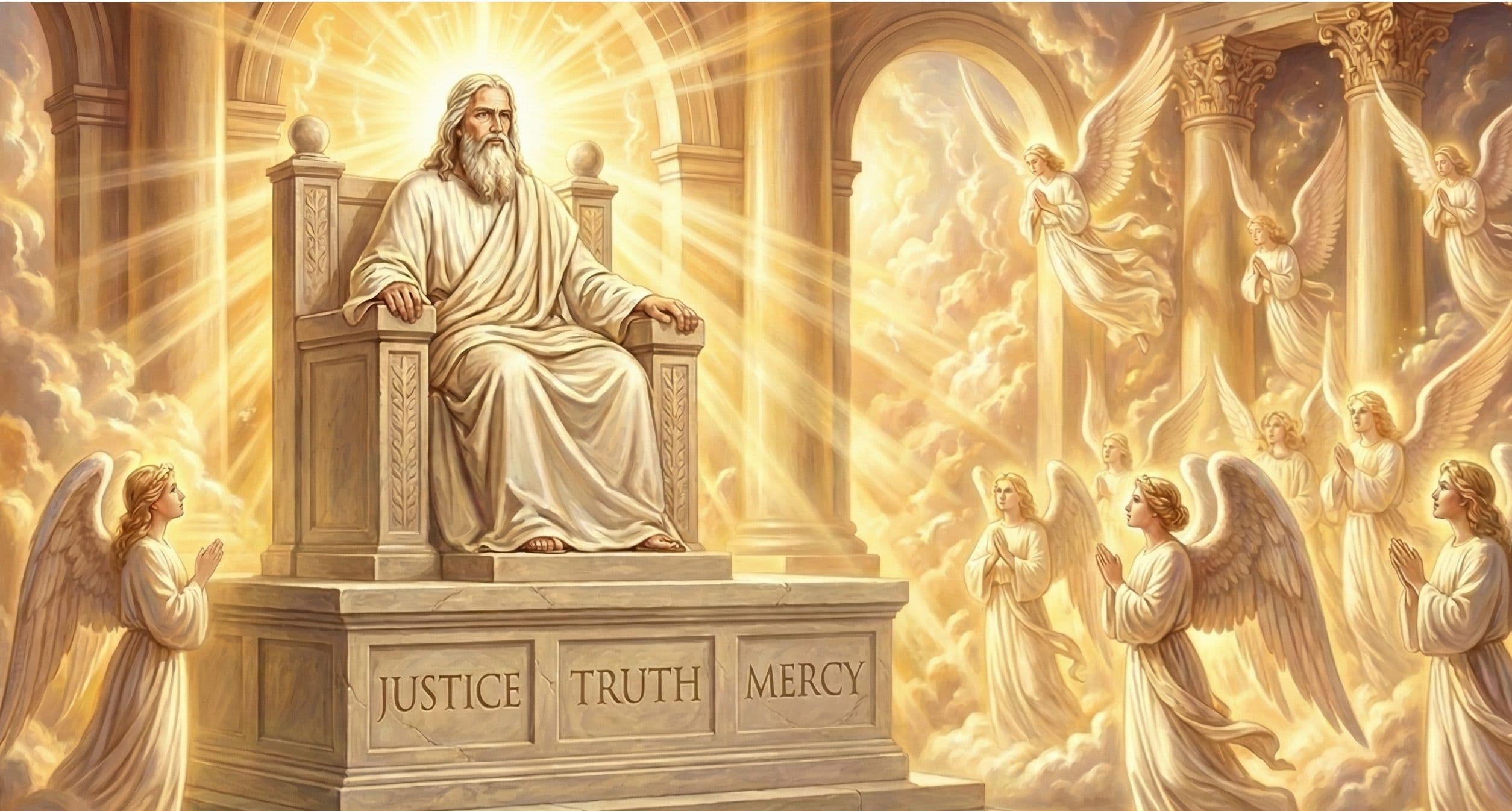
The words of Enoch in Moses 7:31 contain a close paraphrase of Psalm 89:14, a verse that aligns well with extrabiblical Enochic lore.Like the Book of Mormon, the Book of Moses sometimes exhibits clear textual interactions with biblical passages.1 One example is the relationship between Moses 7:31 and Psalm 89:14:
Moses 7 | Psalm 89 |
31 And thou hast taken Zion to thine own bosom, from all thy creations, from all eternity to all eternity; and naught but peace, justice, and truth is the habitation of thy throne; and mercy shall go before thy face and have no end; how is it thou canst weep? | 14 Justice and judgment are the habitation of thy throne: mercy and truth shall go before thy face. |
While the two texts don’t share a verbatim relationship, the order and clustering of key words and phrases result in a very close paraphrase (portions of which, such as “the habitation of thy throne” and “shall go before thy face” could be considered quotations). Those skeptical of Joseph Smith’s prophetic calling might assume he was randomly borrowing biblical content as filler for his made-up revelation concerning the prophet Enoch. However, there are reasons to believe something else is going on.
Connections Between Psalm 89 and Enochic Literature
One thing to consider is how well Psalm 89, as a whole, aligns with extrabiblical Enochic material. Parallels include, but aren’t limited to, God’s incomparable nature (v. 6), the fear and reverence that he evokes for all those surrounding him (v. 7), God’s status as the creator of the heavens and earth (v. 11), the qualities of God’s throne (v. 14), face imagery connected to God’s throne (vv. 14–15), God’s glory and strength being upon the righteous (v. 17), the favored status of God’s chosen servant (vv. 18–19), and a holy anointing ritual (v. 20). All of these thematic elements are present (and several are pervasive) in extrabiblical Enochic traditions and can also be found in the Enoch material of the Book of Moses.2
Similar Interactions in Extrabiblical Sources
Another line of evidence comes from the fact that 3 Enoch 31:1 contains words and phrases that are similar to both Moses 7:31 and Psalm 89:14:3
Moses 7 | Psalm 89 | 3 Enoch 31 |
31 And thou hast taken Zion to thine own bosom, from all thy creations, from all eternity to all eternity; and naught but peace, justice, and truth is the habitation of thy throne; and mercy shall go before thy face and have no end; how is it thou canst weep? | 14 Justice and judgment are the habitation of thy throne: mercy and truth shall go before thy face. | 1 When the Holy One, blessed be he, sits on the throne of judgment. Justice stands on his right hand, Mercy on his left, and Truth stands directly facing him. |
Although the arrangement of content is somewhat different, each text has a combination of five parallel elements: (justice + truth + throne + mercy + before the face). Moreover, both Moses 7 and 3 Enoch 31 have longer matching phrasal elements that help solidify their mutual relationship with Psalm 89.4 As further validation for this proposed relationship, Philip Alexander, in his translation of 3 Enoch, twice indicates that 3 Enoch 31:1 is textually related to Psalm 89:14.5
Destruction by Fire and Water
Further reason for assuming a mutual relationship comes from an intriguing contextual parallel. In both the Book of Moses and 3 Enoch, a description of God’s fiery judgment being poured out upon the wicked is given soon after their respective interactions with Psalm 89:14. In Moses 7:34, the Lord declared concerning the wicked, “And the fire of mine indignation is kindled against them; and in my hot displeasure will I send in the floods upon them.” Thus, we get a combination of fire and water that jointly act as a form of judgment upon the wicked.
Likewise, in the very next verse after the allusion to Psalm 89:14 in 3 Enoch, we read that “by fire will the Lord execute judgment” (3 Enoch 32:1). Note that this chapter is very short, being comprised of only two verses. The next chapter then explains, in detail, how “rivers of fire flow out” from the throne of God and how each river eventually “falls on the heads of the wicked in Gehinnom” (3 Enoch 33:4–5). The peculiarity of this fire/water imagery, showing up shortly after allusions to Psalm 89:14 in each text, is rather intriguing.
Conclusion
Since 3 Enoch wasn’t available in English until 1928, Joseph Smith couldn’t have known that it interacts with Psalm 89:14.6 Nor could he have been aware of the additional water/fire parallel that arises soon afterward. Nor could he have known how thoroughly Psalm 89, as a broader textual unit, aligns with themes that commonly arise in Enochic literature, especially in texts like 2 Enoch and 3 Enoch. Thus, what might at first glance be viewed as a straightforward example of biblical borrowing actually holds subtle and easily overlooked connections to Enochic lore.7 If Joseph Smith randomly drew upon Psalm 89:14, he unknowingly made a very appropriate selection. This is just one of several instances in which bible-related content in the Book of Moses aligns well with extrabiblical Enochic traditions.8
Jeffrey M. Bradshaw, Enoch and the Gathering of Zion: The Witness of Ancient Texts for Modern Scripture (Interpreter Foundation, with Scripture Central and Eborn Books, 2021), 142–143.
Jeffrey M. Bradshaw and David J. Larsen, In God’s Image and Likeness 2: Enoch, Noah, and the Tower of Babel (Interpreter Foundation and Eborn Books, 2014), 143–145.
Hugh Nibley, Enoch the Prophet, The Collected Works of Hugh Nibley, Volume 2 (FARMS, 1986), 258–259.
Moses 7:31
- 1. As for the Book of Mormon’s use of biblical content, various intertextuality studies highlight these interactions. See also Scripture Central, “Book of Mormon Evidence: Brass Plates Consistencies,” Evidence 392 (February 14, 2023).
- 2. For several examples of this overlap, see Scripture Central, “Book of Moses Evidence: A New Creation Account,” Evidence 487 (March 26, 2025); Scripture Central, “Book of Moses Evidence: Enoch’s Right to God’s Throne,” Evidence 498 (June 11, 2025); Scripture Central, “Book of Moses Evidence: Enoch Stood before God’s Face,” Evidence 519 (November 5, 2025); Scripture Central, “Book of Moses Evidence: Enoch’s Divine Comfort and Protection,” Evidence 520 (November 21, 2025); Scripture Central, “Book of Moses Evidence: Enoch’s Divine Favor,” Evidence 490 (April 16, 2025); Scripture Central, “Book of Moses Evidence: Enoch’s Anointing,” Evidence 502 (July 9, 2025).
- 3. All translations from 3 Enoch are from Philip Alexander, “3 (Hebrew Apocalypse of) Enoch,” in The Old Testament Pseudepigrapha, 2 vols., ed. James H. Charlesworth (Doubleday, 1983–85), 1:255–315.
- 4. Moses 7:31 and Psalm 89:14 each mention “the habitation of thy throne,” whereas 3 Enoch 31:1 and Psalm 89:14 express the idea of truth going before God’s face.
- 5. See Alexander, “3 (Hebrew Apocalypse of) Enoch,” 285. This can be seen in the side margin of this passage, as well as in note 31a.
- 6. See Hugo Odeberg, 3 Enoch or the Hebrew Book of Enoch (Cambridge University Press, 1928).
- 7. Even though this psalm is a post-Davidic composition, the origin of the specific throne-related imagery in verse 14 is ultimately unknown. Thus, instead of viewing the Book of Moses as quoting directly from Psalm 89:14, it could be that Psalm 89:14 is itself drawing upon early Enochic lore or that both texts are independently interacting with a separate ancient enthronement tradition. Without more textual and historical data, the direction of influence simply can’t be proven either way.
- 8. Another example involves hell and a prison being prepared for the wicked in Moses 6:29; 7:38, in connection to Matthew 25:41. See Scripture Central, “Book of Moses Evidence: Hell Was ‘Prepared’,” Evidence 510 (September 3, 2025). Another involves the theme of darkness in Moses 6–7, in connection to passages such as 2 Peter 2:4 and Jude 1:6. See Scripture Central, “Book of Moses: Theme of Darkness,” Evidence 479 (January 31, 2025). One can also look at the spiritual rebirth imagery in Moses 6:51–68, in connection with John 3. See Jeffrey M. Bradshaw and Matthew L. Bowen, “‘By the Blood Ye Are Sanctified’: The Symbolic, Salvific, Interrelated, Additive, Retrospective, and Anticipatory Nature of the Ordinances of Spiritual Rebirth in John 3 and Moses 6,” Interpreter: A Journal of Mormon Scripture 24 (2017): 123–316.