Evidence 520 | November 21, 2025
Book of Moses Evidence: Enoch’s Divine Comfort and Protection
Post contributed by
Scripture Central
Abstract
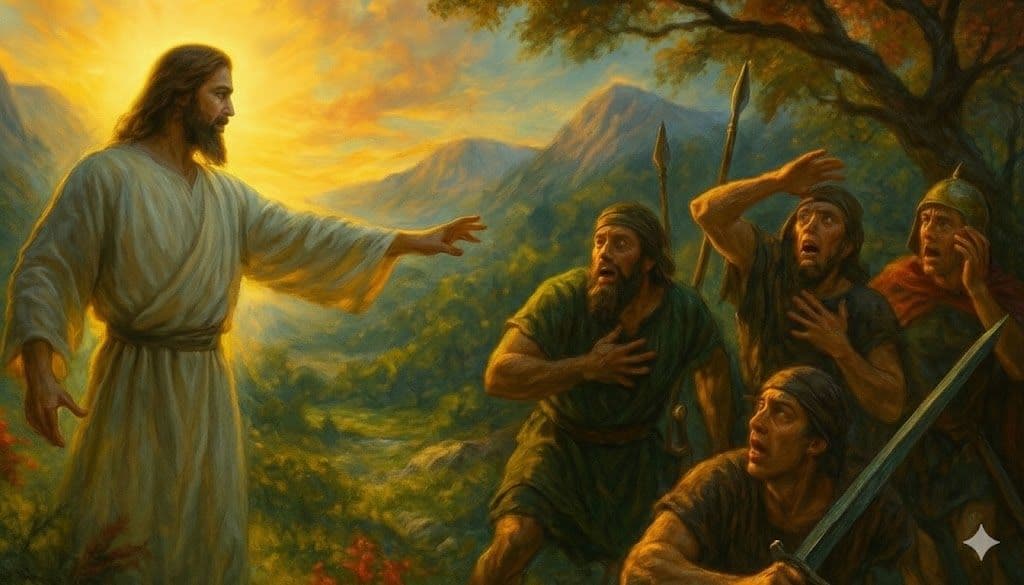
The Book of Moses depicts the Lord offering Enoch comfort and protection in the context of his prophetic commission. Several extrabiblical traditions contain similar details in relevant settings.As part of his prophetic commission, Enoch “bowed himself to the earth, before the Lord, and spake before the Lord, saying: Why is it that I have found favor in thy sight, and am but a lad, and all the people hate me; for I am slow of speech; wherefore am I thy servant?” (Moses 6:31).1 Enoch’s concern about the hate he experienced from others suggests he may have feared they would react violently to his message. Supporting this assumption, the Lord comforted Enoch by declaring, “Go forth and do as I have commanded thee, and no man shall pierce thee” (Moses 6:32).
Comfort Given to Enoch
Several extrabiblical traditions similarly depict Enoch in a state of prostration and fear just before the Lord comforted him. In the context of Enoch’s prophetic calling in 1 Enoch, we read:
Until then I was prostrate on my face covered and trembling. And the Lord called me with his own mouth and said to me … Do not fear, Enoch, righteous man, scribe of righteousness; come near to me and hear my voice. And tell the Watchers of heaven on whose behalf you have been sent to intercede …. For what reason have you abandoned the high, holy, and eternal heaven?”2
A similar statement is made in 2 Enoch: “And I fell down flat and did obeisance to the LORD. And the LORD, with his own mouth, said to me, ‘Be brave, Enoch! Don’t be frightened! Stand up, and stand in front of my face forever.’”3 Although Enoch’s fear in these contexts could partly involve the details of his prophetic commission, it seems more likely that it was due to his physical proximity to the Lord. In ancient Jewish thought, entering into God’s immediate presence and viewing his face was often a terrifying prospect for mortal individuals.4 Still, these texts portray the Lord offering comfort to Enoch when he was in a state of doubt or distress, similar to Joseph Smith’s revelation.
Protection Given to Enoch
Other traditions are even more closely aligned with the Book of Moses, in that they depict God or angels protecting (or promising to protect) Enoch from imminent personal harm posed by his enemies. For instance, in a Mandaean account, an Enoch figure (identified as Enosh5) explained an encounter he had with a divine being known as the Angel of Life:
Then I [Enosh] sought to raise up my body which had prostrated itself before Him, to reassure my heart which fear had frozen, and to strengthen my legs which were trembling in His presence. Yet the Angel of Life said to me: Little Enosh, why are you afflicted? Why is your heart so troubled? Why do you everywhere give forth only the appearance of terror and dread? And I did not dare to reply. Then the Angel of Life said again: Little Enosh, fear nothing; you have dreaded the dangers of this world, and I have come to deliver you from them. Fear not the wicked, fear not the floods which they raise above your head; for their efforts shall be in vain: it shall not be granted to them to do you any harm.6
In a Jewish mystical text known as Havdalah de-Rabbi ‘Aqiva, Enoch is said to possess knowledge of a secret name that can provide protection from any type of harm:
I, Enoch b. Yared, wrote it down in the seventieth year of my youth. Seventy-seven angels came against me, (and) I bound them with their own implements and sealed them with their own weapons. I then turned and discerned this secret through the mystery of the name El, El, El, El, El, El, YHW, YHW, YHW, YHW, YHW, YHW, Ehyeh asher ehyeh, Ehyeh asher ehyeh, Ehyeh asher ehyeh, Ehyeh asher ehyeh, Ehyeh asher ehyeh, HY, HY, HY, HY, HY, HY, HY. It is the most awesome of secrets. This secret of the secrets is for delivering the weak from the grasp of the strong, the lowly from the grasp of the powerful, and the poor from the grasp of the wealthy. When I have invoked it, I, so-and-so, the son of so-and-so, can be rescued, delivered, and saved by it from the power of kings and rulers, and from the power of enemies and adversaries, and from every mortal need, and from the jurisdiction of Gehenna, and from all harsh decrees, and from every kind of retribution, and from any of the progeny of Adam and Eve who rise up against me to cause harm to me. May my mouth be made like the mouth of a lion; (may) my tongue be (made) like the tongue of a heifer; and may I put on a radiance like (that of) fiery horses … You who are a shield for the righteous, may You be a shield and a refuge for me, amen!7
The all-encompassing scope of this protection is notable, as it correlates well with the ability of Enoch to subdue both men and nature in the Book of Moses:
And so great was the faith of Enoch that he led the people of God, and their enemies came to battle against them; and he spake the word of the Lord, and the earth trembled, and the mountains fled, even according to his command; and the rivers of water were turned out of their course; and the roar of the lions was heard out of the wilderness; and all nations feared greatly, so powerful was the word of Enoch, and so great was the power of the language which God had given him. (Moses 7:13)8
It may also be significant that, in each case, Enoch’s protection was facilitated by the power of speech. In the Book of Moses, it was the “word of Enoch” and “the power of the language which God had given him” that saved him and his people. Likewise, in the Jewish text, invoking a particular name of deity brought about the divine intervention.9
Islamic sources also have traditions regarding Enoch’s protection, whom they identify as the prophet Idris. An account from Pseudo-Mas‘ūdī tells the story of Satan (known as Iblis) coming among the people to deceive them.10 He specifically conversed with a king named Yamaḥuel and warned him that Idris may pose a threat to the king, especially because Enoch would undermine idol worship.11 It is then reported that no harm could come to Idris because he was protected by the angels:
Then Yamaḥuel said: “Can you bring about his demise?” He (Iblis [Satan]) answered: “I will endeavor to do so.” But God assigned for Idrīs [Enoch] angels to protect him, and when Iblis [Satan] and some of those who were with him from his forces came (to do Idrīs harm), they kept them from harming him. … His father put him unharmed in the temple, and he taught him the writings.12
Protective Anointing and Clothing Ordinances
In several traditions, Enoch is seen as inheriting the light and glory that once belonged to Adam and Eve when they were in Eden. Some sources describe this light being bestowed upon him specifically through anointing and clothing ordinances. One source from the Jewish Zohar relates the following:
And when the Holy One, blessed be He, created Adam the Protoplast, He introduced him into the Garden of Eden (clothed) in a garment of glory that was consubstantial with the light of the Garden of Eden … [but he sinned] and those garments flew off of him, and the luminous soul which opened a window to what was above departed from him, and he was left stripped of all (these things) … and that luminosity of the supernal soul which flew away from him ascended upwards, and it was put away into a certain treasury which was the “Body” until the time that he engendered offspring and Enoch came into the world. When Enoch came, that supernal light—the holy soul—descended into him, and Enoch was invested with the supernal dignity which had left Adam, as scripture affirms: “And Enoch walked with God, etc.” (Gen 5:21).13
Likewise, we read in 2 Enoch 22:8–10:
And the LORD said to Michael, “Go, and extract Enoch from [his] earthly clothing. And anoint him with my delightful oil, and put him into the clothes of my glory.” And so Michael did, just as the LORD had said to him. He anointed me and he clothed me. And the appearance of that oil is greater than the greatest light, and its ointment is like sweet dew, and its fragrance myrrh; and it is like the rays of the glittering sun. And I looked at myself, and I had become like one of his glorious ones, and there was no observable difference.14
Importantly, both the anointing and clothing of Enoch have connotations of protection. For instance, concerning the Edenic light (Hebrew: shekinah) we read in 3 Enoch that “anyone who gazed at the brightness of the Šekinah was not troubled by flies or gnats, by sickness or pain; malicious demons were not able to harm him, and even the angels had no power over him.”15 In other words, the glory of God shielded one from various types of harm and danger.16 This gives added meaning to later passages in 3 Enoch in which Metatron (Enoch in his glorified angelic state) is specifically said to have been clothed in glorious attire:
Out of the love which he had for me, more than for all the denizens of the heights, the Holy One, blessed be he, fashioned for me a majestic robe, in which all kinds of luminaries were set, and he clothed me in it. He fashioned for me a glorious cloak in which brightness, brilliance, splendor, and luster of every kind were fixed, and he wrapped me in it.17
The oil with which Enoch was anointed in 2 Enoch is also connected to Eden.18 In several traditions, when Adam was nearing his death, he requested that his family members return to Eden and retrieve oil from the Tree of Life. This oil, although the angel Michael forbade it being applied to Adam at the time, was presumably able to heal Adam from his afflictions. Later, it becomes clear that this oil was associated with the power of the resurrection.19
Remarkably, not only are these anointing and clothing motifs found in a variety of ancient and medieval Enochic sources, but they both turn up in the Book of Moses (although with some variation when it comes to the anointing; see Moses 6:35–36; 7:3). Detailed analyses of these parallels have been undertaken in other evidence articles.20 The main point here is simply that the anointing and clothing of Enoch ties into the theme of him receiving divine protection, since they essentially facilitated his transformation into an angelic being. As explained by Andrei Orlov, “The anointing with the oil causes the patriarch’s transformation from the garments of skin to the luminous garment of an immortal angelic being, one of the glorious ones.”21
This point is further corroborated in the Book of Mormon, which teaches that translated beings have a change wrought upon their bodies making them impervious to all mortal danger and even death.22
Conclusion
Most of the texts discussed throughout this article would have been inaccessible to Joseph Smith in 1830, either because they hadn’t yet been discovered by Western scholars or because they were obscure and hadn’t been translated into English. The sole exception is 1 Enoch. This work had been translated into English by Richard Laurence in 1821, and a number of extracts of the text had been made available to the public in a variety of sources both before and after Laurence’s translation. That being said, there is ongoing debate about how likely it was that Joseph Smith ever accessed this source.23 More importantly, even if it could be proven that he did encounter 1 Enoch, it would have been of limited value, since it only depicts God comforting Enoch (likely in relation to fear of being in God’s presence) but says nothing about Enoch being protected from external harm or danger.
Much stronger parallels come from sources that would have been inaccessible at the time. The Mandaean account is probably the most significant of these, since Enosh (Enoch) is given a promise of divine protection in a context that is remarkably similar to that found in the Book of Moses, with multiple contextual parallels all converging at once.24 The account of God assigning angels to protect Enoch from his enemies in Pseudo-Mas‘ūdī is also on point, as the harm posed to him specifically came from mortal adversaries who were upset by Enoch’s threat to their rule and idol worship. At the same time, Enoch’s knowledge of a secret protective name in Havdalah de-Rabbi ‘Aqiva aligns well with his ability to overcome all powers and enemies in Moses 7:13. When one adds in the protective anointing and clothing motifs, the case becomes even stronger.
Overall, the Book of Moses exhibits a remarkable—and, in several cases, quite nuanced—congruity with a variety of extrabiblical traditions regarding the divine comfort and protection given to Enoch. Since the majority of these parallels aren’t found in the Bible and weren’t available in Joseph Smith’s environment, they provide support for the antiquity of the Book of Moses, as well as his prophetic calling.
Jeffrey M. Bradshaw, Enoch and the Gathering of Zion: The Witness of Ancient Texts for Modern Scripture (Interpreter Foundation, with Scripture Central and Eborn Books, 2021), 48.
Moses 6:31–32
Moses 6:35
Moses 7:3
Moses 7:13
- 1. See Scripture Central, “Book of Moses Evidence: Enoch’s Prophetic Commission,” Evidence 485 (March 12, 2025); Scripture Central, “Book of Moses Evidence: Enoch’s Divine Favor,” Evidence 490 (April 16, 2025); Scripture Central, “Book of Moses Evidence: Enoch the Lad,” Evidence 480 (February 6, 2025); Scripture Central, “Book of Moses Evidence: Slow of Speech,” Evidence 496 (May 28, 2025).
- 2. 1 Enoch 14:24–15:1. Translation by E. Isaac, “1 (Ethiopic Apocalypse of) Enoch,” in The Old Testament Pseudepigrapha, 2 vols., ed. James H. Charlesworth (Doubleday, 1983–85), 1:21.
- 3. 2 Enoch 22:4–5 (J). Translation by Frances I. Anderson, “2 (Slavonic Apocalypse of) Enoch,” in The Old Testament Pseudepigrapha, 1:136.
- 4. As Enoch himself later explained in 2 Enoch 39:8, “Frightening and dangerous it is to stand before the face of an earthly king, terrifying and very dangerous it is, because the will of the king is death and the will of the king is life. How much more terrifying and dangerous it is to stand before the face of the King of earthly kings and of the heavenly armies?” Translation by Anderson, “2 (Slavonic Apocalypse of) Enoch,” 164. For more commentary on this topic, see Andrei A. Orlov, The Enoch-Metatron Tradition, Texts and Studies in Ancient Judaism 107 (Mohr Siebeck, 2005), 285–286. See also Scripture Central, “Book of Moses Evidence: Enoch Stood Before God’s Face,” Evidence 519 (November 5, 2025).
- 5. This type of overlapping of identities and roles actually isn’t that unexpected, since Enosh and Enoch have been conflated in a number of sources, both ancient and modern. See by Jeffrey M. Bradshaw, Enoch and the Gathering of Zion: The Witness of Ancient Texts for Modern Scripture (Interpreter Foundation, with Scripture Central and Eborn Books, 2021), 7. Note that Enosh is an alternate spelling of the name Enos, which is how the name is transliterated in the King James Bible (see Genesis 4:26).
- 6. Jacques P. Migne, “Livre D’Adam,” in Dictionnaire des Apocryphes, ou, Collection de tous les livres Apocryphes relatifs a l’Ancien et au Nouveau Testament, ed. Jacques P. Migne, 2 vols (Paris, France: Jacques P. Migne, 1856), 167. This English translation from French was provided by ChatGPT and corroborated by Google Gemini. The underlying text reads: “puis je cherchai à redresser mon corps qui s’était prosterné devant lui, à rassurer mon cœur que la crainte avait glacé, et à fortifier mes jambes qui fléchissaient en sa présence. Cependant l’ange de la Vie me dit : Petit Anusch, pourquoi t’affliges-tu? pourquoi ton cœur est-il ému? pourquoi donnes-tu enfin partout l’apparence de la terreur et de l’effroi? Et moi, je n’osai pas répondre. Alors l’ange de la Vie me dit encore : Petit Anusch, ne crains rien; tu as redouté les dangers de ce monde, je suis venu à toi pour t’en délivrer. Ne crains point les méchants, ne crains point les déluges qu’ils soulèvent sur ta tête; car leurs efforts seront vains: il ne leur sera pas donné de te faire aucun mal.” The idea of the wicked trying to destroy Enosh/Enoch with water is also interesting, since Enoch specifically turned the course of rivers in the context of protecting his people in the Book of Moses (Moses 7:13; cf. 6:34). See Scripture Central, “Book of Moses Evidence: Rivers Turned from Their Course,” Evidence 514 (October 1, 2025); Bradshaw, Enoch and the Gathering of Zion, 48.
- 7. Havdalah de-Rabbi ‘Aqiva §8 (ed. Scholem); as cited John C. Reeves and Annette Yoshiko Reed, Enoch from Antiquity to the Middle Ages: Sources from Judaism, Christianity, and Islam (Oxford University Press, 2018), 167.
- 8. The phrase “May my mouth be made like the mouth of a lion” is also fascinating, as it corresponds to the “roar of the lions” in the Book of Moses. See Scripture Central, “Book of Moses Evidence: The Roar of Lions,” Evidence 517 (October 22, 2025).
- 9. In each text, the speech-related protection may relate to priesthood power, in which miraculous feats can be carried out specifically in the name of God. Remarkably, other revelations from Joseph Smith likewise connect Enoch with both priesthood power and with the type of superlative, all-encompassing protection described in the Jewish source. In Doctrine and Covenants 76:57–60 we read: “They are they who are priests and kings, who have received of his fulness, and of his glory; And are priests of the Most High, after the order of Melchizedek, which was after the order of Enoch, which was after the order of the Only Begotten Son. Wherefore, as it is written, they are gods, even the sons of God—Wherefore, all things are theirs, whether life or death, or things present, or things to come, all are theirs and they are Christ’s, and Christ is God’s. And they shall overcome all things.” Even more relevant material turns up in JST Genesis 14:30–31: “For God having sworn unto Enoch and unto his seed with an oath by himself; that every one being ordained after this order and calling should have power, by faith, to break mountains, to divide the seas, to dry up waters, to turn them out of their course; To put at defiance the armies of nations, to divide the earth, to break every band, to stand in the presence of God; to do all things according to his will, according to his command, subdue principalities and powers; and this by the will of the Son of God which was from before the foundation of the world.”
- 10. For more on this topic, see Scripture Central, “Book of Moses Evidence: Satan’s Deceptions,” Evidence 489 (April 10, 2025).
- 11. The name Yamaḥuel is significant. In a footnote regarding this name, the authors explain, “The figure intended seems to be Meḥuyael (מחויאל) b. ʿIrad from the Cainite genealogy in Gen 4:18.” Pseudo-Mas‘ūdī, Akhbār al-zamān wa-min abādat al-hidthān; as cited Reeves and Reed, Enoch from Antiquity to the Middle Ages, 157n22. This is remarkable because the only other named character in the Enoch account in the Book of Moses was a man called Mahijah (Moses 6:40), or possibly Mahujah (Moses 7:2)—name variants which, like Yamaḥuel, closely correspond to Mehujael in Genesis 4:18. Pseudo-Mas‘ūdī, Akhbār al-zamān wa-min abādat al-hidthān; as cited Reeves and Reed, Enoch from Antiquity to the Middle Ages, 157–158. For in-depth treatments of this name, see Jeffrey M. Bradshaw, Matthew L. Bowen and Ryan Dahle, “Textual Criticism and the Book of Moses: A Response to Colby Townsend’s “Returning to the Sources,” Part 1 of 2,” Interpreter: A Journal of Latter-day Saint Faith and Scholarship 40 (2020): 99–162; Jeffrey M. Bradshaw, Matthew L. Bowen and Ryan Dahle, “Where Did the Names Mahaway and Mahujah Come From? A Response to Colby Townsend’s ‘Returning to the Sources,’ Part 2 of 2,” Interpreter: A Journal of Latter-day Saint Faith and Scholarship 40 (2020): 181–242.
- 12. Pseudo-Mas‘ūdī, Akhbār al-zamān wa-min abādat al-hidthān; as cited Reeves and Reed, Enoch from Antiquity to the Middle Ages, 157–158. Also of interest is the fact that Enoch’s righteous instruction from his father is mentioned in this passage. This point is likewise emphasized in the Book of Moses in connection to Enoch’s prophetic commission to preach to the people. See Scripture Central, “Book of Moses Evidence: Enoch, a Student of Righteousness,” Evidence 483 (February 26, 2025). In another Islamic source, Idris persuaded the Angel of Death to let him take a tour of hell, comparable to Enoch’s vision of hell in Moses 7:25–26. However, upon beholding the scene, Idris became distressed and fell unconscious. The Angel of Death then took him away from that location and declared when Idris awoke, “I do not want to injure you. For the sake of your friendship, I will be careful to do you no harm!” Idris then persuaded the angel to escort him into paradise, a location which Idris refused to leave after entering. After a dispute arose between Idris and the Angel of Death about whether Idris could stay, the Lord’s voice could be heard saying to the Angel of Death, “My servant [Idris] has defeated you.” Pseudo-Aṣmaʿī, Nihāyat al-arab fī akhbār al-Furs wa’l-ʿArab (ed. Dānish-Pazhūh); as cited Reeves and Reed, Enoch from Antiquity to the Middle Ages, 191–192. Although this is a somewhat looser parallel than the others, it is still interesting that care was given by the Angel of Death to protect Idris (Enoch) and also that Enoch eventually overcame death itself, the epitome of physical harm. This outcome—of Enoch overcoming death in a paradise setting—is relevant to the section below.
- 13. Zohar Ḥadash, Midrash Ha-neʿelam to Shir ha-Shirim fol. 69a–b (ed. Margaliot); as cited in Reeves and Reed, Enoch from Antiquity to the Middle Ages, 299.
- 14. Translation by Anderson, “2 (Slavonic Apocalypse of) Enoch,” in The Old Testament Pseudepigrapha, 2 vols., ed. James H. Charlesworth (Doubleday, 1983–85), 1:138.
- 15. 3 Enoch 5:4. Translation by Philip Alexander, “3 (Hebrew Apocalypse of) Enoch,” in The Old Testament Pseudepigrapha, 1:259–260.
- 16. A related concept is reported in The Investiture of Abbaton, where Satan is stripped of his protective clothing before being thrown down to earth (analogous to Adam and Eve being stripped of their glorious garments after their Fall). In this text, the Savior explained to his apostles, “When my Father saw his [Satan’s] great pride, that his malfeasance and entire mischief had become full, he ordered the entire heavenly hosts saying to them, ‘Come and take the roll from the hand of the proud one, strip off his armor and throw him down to earth, for his time has come.’” Investiture of Abbaton 6:2. Translation by Ibrahim Saweros and Alin Suciu, “The Investiture of Abbaton, the Angel of Death,” in New Testament Apocrypha: More Noncanonical Scriptures, vol. 1, ed. Tony Burke and Brent Landau (Eerdmans, 2016), 538–39.
- 17. 3 Enoch 12:1–3. Translation by Alexander, “3 (Hebrew Apocalypse of) Enoch,” 265.
- 18. See Orlov, The Enoch-Metatron Tradition, 230–231.
- 19. See Life of Adam and Eve 40:1–2 (Vita). Translation by M. D. Johnson, “Life of Adam and Eve,” in Old Testament Pseudepigrapha, (Doubleday, 1985), 2:275.
- 20. See Scripture Central, “Book of Moses Evidence: Enoch’s Anointing,” Evidence 502 (July 9, 2025); Scripture Central, “Book of Moses Evidence: Enoch Clothed with Glory,” Evidence 500 (June 25, 2025).
- 21. Orlov, The Enoch-Metatron Tradition, 229–230.
- 22. See 3 Nephi 28:37–39: “But behold, since I wrote, I have inquired of the Lord, and he hath made it manifest unto me that there must needs be a change wrought upon their bodies, or else it needs be that they must taste of death; Therefore, that they might not taste of death there was a change wrought upon their bodies, that they might not suffer pain nor sorrow save it were for the sins of the world. Now this change was not equal to that which shall take place at the last day; but there was a change wrought upon them, insomuch that Satan could have no power over them, that he could not tempt them; and they were sanctified in the flesh, that they were holy, and that the powers of the earth could not hold them.”
- 23. See Jeffrey M. Bradshaw and Ryan Dahle, “Could Joseph Smith Have Drawn on Ancient Manuscripts When He Translated the Story of Enoch?: Recent Updates on a Persistent Question,” Interpreter: A Journal of Latter-day Saint Faith and Scholarship 33 (2019): 305–374, esp. 308–311; For reasons to be cautious in assuming it was implausible for Joseph Smith to have learned anything about 1 Enoch, see Colby Townsend, “Revisiting Joseph Smith and the Availability of the Book of Enoch,” Dialogue 53, no. 3 (2020): 41–71.
- 24. For a more comprehensive analysis of these parallels, see Scripture Central, “Book of Moses Evidence: Rivers Turned from Their Course,” Evidence 514 (October 1, 2025).