Evidence #533 | February 19, 2026
Book of Mormon Evidence: Dragons
Post contributed by
Scripture Central
Abstract
The descriptions of “dragons” within the Book of Mormon fit well in both ancient Near Eastern and ancient American contexts.One aspect of the Book of Mormon that sometimes turns heads is its four usages of the word dragon. Two of these occur in quotations from Isaiah (2 Nephi 8:9; 23:22; cf. Isaiah 13:22; 51:9), which is perhaps not surprising since the word can be found in many passages of the King James Bible. However, the term is also used in two passages unique to the Book of Mormon, both times appearing as a simile for fierce fighters (Mosiah 20:11; Alma 43:44). Readers may be surprised by these occurrences and ask why dragons—widely viewed today as mythical creatures—are mentioned in the Book of Mormon.
Because the Nephite conception of dragons may originally derive from the Israelite worldview, it is worthwhile to summarize what dragons represented in the Near East and in the Hebrew Bible particularly. The Hebrew word translated as “dragon” (tannin) is a broad term that typically describes reptilian creatures of various sizes, including snakes, crocodiles, and even legendary sea serpents.1 Tannin is sometimes translated as “whale” in the King James Bible, but that association is somewhat conjectural.2
While tannin is also occasionally described as a land-dwelling creature, it is primarily associated with water and is typically described in or with water.3 Similar to other dragon-like creatures in Near Eastern contexts, tannin may represent the watery chaos that preceded Creation. Many Near Eastern cultures connect the slaying of a primordial sea monster to the dawn of Creation.4 This imagery also seems to be evoked in several biblical passages, which make reference to Jehovah slaying a great sea monster (tannin) as part of the Creation. This creature is sometimes even given a proper name like Rahab.5
The Hebrew conception of tannin may also be behind some of the Book of Mormon’s usages of the word “monster.”6 After quoting an Isaiah passage about God slaying a tannin, Jacob repeatedly personified death, hell, and the devil as an “awful monster” from which God “delivereth his saints.”7 Tannin might also be the concept behind the “monster of the sea” that Moroni mentioned along with “whale” in Ether 6:10.
As Latter-day Saint scholars like John L. Sorenson and Matthew Roper have noted, many of these Old-World conceptions of a tannin could have easily translated to both the biological and cultural environment of the New World. Speaking of Mormon’s mention of dragons in Mosiah 20:11, Sorenson explains:
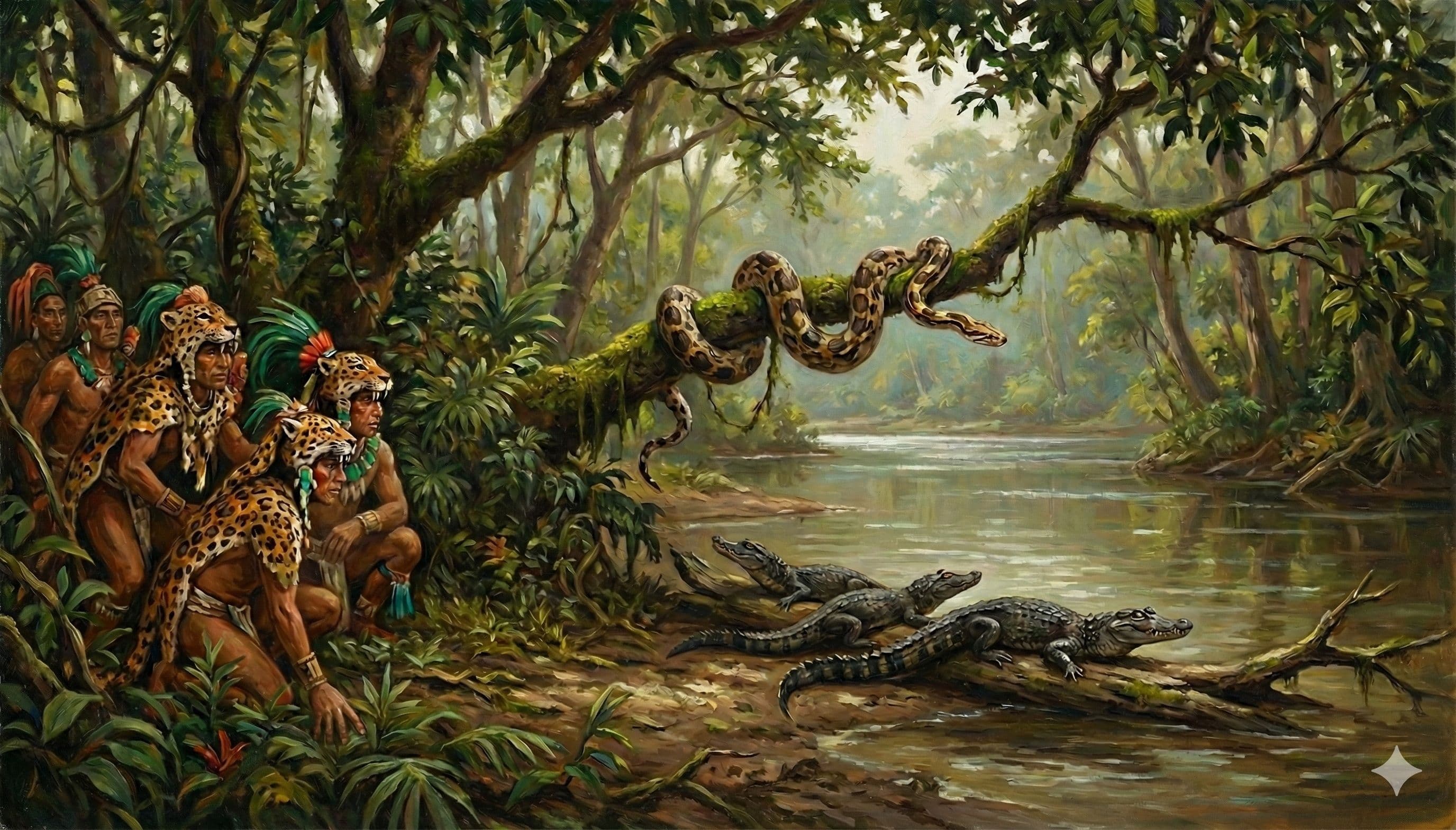
What kind of “dragons” did he have in mind? The reference was probably to the crocodile or caiman. … But this “dragon” was much more than a dangerous bit of the natural world. In Mesoamerican mythology a giant creature of crocodilian form was thought to float on the supposed subterranean sea. His back was the surface of the earth, and his connection with earth and waters tied him symbolically with productivity and fertility. This “earth monster” is repeatedly shown at the base of relief carvings. … We can at least note two things about Zeniff’s dragon imagery: (1) it had powerful meaning to his listeners—beyond being a mere literary phrase, and (2) the complex of ideas is represented not only in the Book of Mormon but in Palestine and in Mesoamerica as well.8
Several species of crocodilians (including crocodiles, alligators, and caimans) can be found in the Americas.9 Early accounts of these creatures have noted their ferocity, as they have sometimes attacked humans and even caused fatalities.10 The Americas are also home to dangerous serpents like pit vipers, as well as many aquatic or semi-aquatic serpents such as water snakes, garter snakes, and the venomous yellow-bellied sea snake.11
While the biological underpinnings of an Old-World tannin or dragon can be nicely mapped onto New-World animals, there is also a conceptual overlap with the mythological idea of a dragon in the New World.12 Indeed, ancient American societies had many cultural and mythological parallels to the tannin as a supernatural and violent reptilian monster, one that was frequently associated with water.13 One striking example comes from a mural in Tulum, as well as an associated image in the Dresden Codex, which each depict a cosmic flood of water pouring from the mouth or body of an enormous crocodile.14 In addition, water itself was sometimes personified as a serpent.15
One Creation story from the New World describes the death of a giant crocodile or caiman and how its body was then used to form the earth and the sky. This is not dissimilar to the Creation stories of Near Eastern cultures, in which a monster living in a primordial ocean was slain.16 In the New-World myth, the earth itself was considered to be the back of either a giant crocodilian or turtle.17 Such creatures were sometimes portrayed with trees or other terrestrial features growing from them.18 The Popul Vuh, for example, recounts how the Hero Twins defeated a giant crocodilian monster who could form mountains.19 Thus, crocodilians became a symbol not only of water but also of the earth and fertility. Interestingly, in modern scholarship the term dragon is sometimes used to describe these creatures and the animals they are based upon.20
The serpent was a sacred symbol in ancient Israel, and several Old-World cultures deified the serpent or portrayed it as a supernatural being.21 New-World cultures also often deified the serpent, and many New-World deities appear in serpentine or even crocodilian form.22 Not all reptilian deities were water-related, nor were they always warlike. Nor were all water deities warlike, but there certainly was overlap between these themes.23 Deities like K’uk’ulkan and Tlaloc could be portrayed as both reptilian and aquatic.24 Moreover, the sea itself was sometimes depicted as a place of violence.25 One of the primary supernatural beings associated with war was the War Serpent, which was associated with the water deity K’uk’ulkan.26
Combat in ancient Mesoamerica seems to have been sometimes conceptualized as fighters zoomorphically transforming into supernatural beings during conflict.27 Maya royalty, for instance, were accompanied in processions by battle beasts, representatives of spiritual animals (called wayob), into which the kings were thought to transform in combat.28 Although the wayob were typically represented as jaguars, some have argued that the associated imagery is actually crocodilian or some combination of jaguar and crocodile.29 These spiritual animals were also sometimes depicted as serpentine creatures.30 Both serpents and crocodiles were featured on Maya headdresses.31
Considering these combat associations, it is quite possible that these ideas are in some way connected to the Nephite imagery of fighting “like dragons.”32 Though the dragon (from the Greek drakon) became a symbol for the devil in the Revelation of John and in Christianity generally, the Book of Mormon usage—and incidentally, the Mesoamerican usage—appears to be more neutral, as both the Lamanites and Nephites are said to have fought “like dragons” in military contexts.33
Conclusion
To modern readers, it may seem strange that ancient cultures believed in the existence of fantastical creatures or would have ascribed supernatural qualities to real animals in their environments.34 While some within Israelite and Nephite society may have literally believed in mythical creatures, many mentions of these creatures in Hebrew and Nephite scripture appear to be primarily figurative or polemical.35 Yet even if non-scientific beliefs were held about such animals, scripture teaches that God speaks to all nations according to their own language and that he is able to accommodate the cultural worldviews of all peoples, giving them as much truth as he sees fit and in ways they can understand (D&C 1:24; Alma 29:8).
Ultimately, knowing that all these conceptions of the Hebrew term tannin (including serpents, crocodiles, and legendary primordial sea monsters) were familiar in a New-World setting helps dispel accusations that the word dragon is out of place in the Book of Mormon.36 The term could reasonably designate a number of ferocious creatures that the Lehites would have been familiar with and that were religiously and culturally significant among Near Eastern and American societies in antiquity.
Matthew Roper, “Anachronisms: Accidental Evidence in Book of Mormon Criticisms,” Interpreter: A Journal of Latter-day Saint Faith and Scholarship 65 (2025).
Bible
Deuteronomy 32:33
Nehemiah 2:13
Job 30:29
Psalm 74:13
Psalm 91:13
Psalm 148:7
Isaiah 13:22
Isaiah 27:1
Isaiah 34:13
Isaiah 35:7
Isaiah 43:20
Isaiah 51:9
Jeremiah 9:11
Jeremiah 10:22
Jeremiah 14:6
Jeremiah 49:33
Jeremiah 51:34
Jeremiah 51:37
Ezekiel 29:3
Micah 1:8
Malachi 1:3
Revelation 12:3–17
Revelation 13:1–11
Revelation 16:13
Revelation 20:2
Book of Mormon
2 Nephi 8:9
2 Nephi 23:22
Mosiah 20:11
Alma 43:44
- 1. J. W. van Henten, “Dragon,” in Dictionary of Deities and Demons in the Bible, ed. Karel van der Toorn, Bob Becking, and Pieter W. van der Horst (Brill, 1999), 265. Several biblical instances of the word dragon quite likely refer to a serpent (Psalm 91:13; Deuteronomy 32:33), though the location of the Nile makes a few instances, including the snake-eating tannin of Aaron’s rod, seem likely to be a crocodile (Exodus 7:9–10, 12; Ezekiel 29:3; 32:2). “Aaron’s rod is transformed before Pharaoh into a tannin (Exod. 7:8–13)—which term, given its associations with the cosmic dragon as well as with the story’s setting near the Nile, should be translated as ‘crocodile.’ … [But] sometimes a snake is just a snake.” Robert S. Kawashima, “Biblical Narrative and the Birth of Prose Literature,” in The Oxford Handbook of Biblical Narrative, ed. Danna Nolan Fewell (Oxford University Press, 2015), 55. This term is used four times in the Psalms, six times in Isaiah, six times in Jeremiah, and once each in Micah, Job, Malachi, and Ezekiel, so it would not have been unknown to Lehi and Nephi.
- 2. The term whale is used in the King James Version in several passages: Genesis 1:21; Isaiah 27:1; 51:9; Psalms 74:13; 148:7; Job 7:12. Modern scholarship veers away from this translation. For example, the Hebrew and Aramaic Lexicon of the Old Testament does not list the term as a valid translation option for tannin, instead listing “sea monster,” “sea dragon,” “dragon,” “serpent,” and “crocodile.” Ludwig Koehler, Walter Baumgartner, and Johann J. Stamm, The Hebrew and Aramaic Lexicon of the Old Testament, ed. Mervyn E. J. Richardson, 2 vols. (Leiden, NL: Brill, 2001), s.v. “תַּנִּין,” hereafter cited as HALOT. The creature that swallows Jonah, often conceptualized as a whale or shark, is described instead as a “great fish” (dag gadol; Jonah 1:17). However, it has been argued that Jonah’s great fish may have also been conceptualized as a tannin. See Scott B. Noegel, “Jonah and Leviathan,” Henoch 37, no. 2 (2015): 236–260.
- 3. Many mentions of dragons on land in the King James Version are probably mistranslations of a homonym meaning “jackal.” The Hebrew word for “dragon” (תַּנִּין) is very similar to the word for “jackal” (תַּן), a non-supernatural canid similar to a wolf, dog, or fox. This explains one usage of the word dragon in the Book of Mormon, as well as most of its usages in the King James Version of the Bible: 2 Nephi 23:22; Isaiah 13:22. See also Isaiah 34:14; 35:7; 43:20; Psalm 44:19; Jeremiah 9:11; 10:22; 14:6; 49:33; 51:37; Nehemiah 2:13; Malachi 1:3. HALOT, s.v. “תַּן.” The word tannin may refer to a non-aquatic dragon, though, when Jeremiah uses it as a symbol for Nebuchadnezzar or in the name of the Dragon’s Spring, as these references are less directly Israelite (Jeremiah 51:34; Nehemiah 2:13). Van Henten, “Dragon,” 265.
- 4. Van Henten, “Dragon,” 265: “Mesopotamian, Hittite, Canaanite, Egyptian, Iranian and Greek myths describe battles between a figure representing chaos and causing rebellion and a (still young) supreme god who restores the order of the gods by overcoming the monster. … The conflict usually takes place in primaeval ages.”
- 5. See C. Uehlinger, “Leviathan,” in Dictionary of Deities and Demons, 511–515; K. van der Toorn, “Rahab,” in Dictionary of Deities and Demons, 684–687; Van Henten, “Dragon,” 265–267; G. C. Heider, “Tannin,” in Dictionary of Deities and Demons, 834–836. Sometimes tehom and yam—the Hebrew words for “the deep” and “sea”—are considered to be personified chaos monsters. For example, in Ugaritic writings and potentially some Bible passages, the sea was personified as a dragon named Yam. F. Stolz, “Sea,” in Dictionary of Deities and Demons, 737–742. This imagery may also be in effect in Old Testament passages like Isaiah 51:9–10 (quoted in 2 Nephi 8:9–10). B. Alster, “Tiamat,” in Dictionary of Deities and Demons, 867–869. There is considerable overlap between these, and it is uncertain whether they are identical. “[Some] issues concerning the Ugaritic evidence have generated some debate. … [Are] tnn, ltn, and ym separate monsters or different names/epithets for the same being?” Heider, “Tannin,” 835. See also Scripture Central, “Book of Mormon Evidence: Isaiah’s Monster in Jacob’s Teachings,” Evidence 486 (March 19, 2025); Scripture Central, “Why Do We Have Three Different Accounts of the Creation? (2 Nephi 2:22),” KnoWhy 400 (January 18, 2018); Scripture Central, “Why Does Jacob Describe God as a Divine Warrior? (2 Nephi 6:17),” KnoWhy 277 (February 20, 2017).
- 6. Scripture Central, “Why Does Jacob Choose a ‘Monster’ as a Symbol for Death and Hell? (2 Nephi 9:10),” KnoWhy 34 (February 16, 2016). Some Lamanites thought Ammon was a monster, though his human appearance to them suggests that he probably wasn’t considered a tannin since these were not anthropomorphic. The Hebrew Bible describes several other supernatural creatures, some of which could have been behind the Lamanites’ conception of Ammon, though they may have had a more ancient American concept in mind or perhaps a unique Lamanite one.
- 7. See 2 Nephi 8:9; 9:10,19, 26. See also Scripture Central, “Book of Mormon Evidence: Isaiah’s Monster in Jacob’s Teachings,” Evidence 486 (March 19, 2025);
- 8. John L. Sorenson, An Ancient American Setting for the Book of Mormon (Foundation for Ancient Research and Mormon Studies [FARMS], 1985), 187–188. See also John L. Sorenson, Mormon’s Codex (Neal A. Maxwell Institute for Religious Scholarship and Deseret Book, 2013), 321: “Fitting also is the imagery of ‘dragons.’ The obvious ‘dragon’ of Mexico and Central America is the crocodile, or caiman. … This creature was a powerful image to represent a warrior.”
- 9. The crocodilian genera of Alligator, Melanosuchus, Paleosuchus, Caiman, and Crocodylus are all found in the New World. However, the only genera found in Mesoamerica are Caiman and Crocodylus, so these are almost certainly the crocodilians described and depicted in the ancient Mesoamerican cultures as mentioned later. In particular, the species Crocodylus acutus, Crocodylus moreletii, and Caiman crocodilus are found in Mesoamerica. Francisco Villamarin, Armando H. Esobebdo-Galván, Pablo Siroski, and William E. Magnusson, “Geographic Distribution, Habitat, Reproduction, and Conservation Status of Crocodilians in the Americas,” in Conservation Genetics of New World Crocodilians, ed. Rodrigo Barban Zucoloto, Patricia Susana Amavet, Luciano Martins Verdade, and Izeni Pires Farias (Springer, 2021), 1–30.
- 10. Terry Stocker, Sarah Meltzoff, and Steve Armsey, “Crocodilians and Olmecs: Further Interpretations in Formative Period Iconography,” American Antiquity 45, no. 4 (October 1980): 747: “Humans may hunt crocodiles for food, but the opposite also happens. Crocodilians are definitely predators on the human population. Their attacks are not abnormal as with isolated cases of other animals; rather the human is a regular part of crocodilian cuisine. This is certainly an anomalous trait and one with which Precolumbian peoples must have dealt.” An early Spanish source described American crocodilians as “very ferocious, and greatly feared by the people. … Some of the caimans are from twenty to thirty feet and upwards in length, with large bodies and big feet, and covered with scales through which a musket ball cannot pierce. Their tails are very powerful and dangerous; and their mouths are large, with three rows of formidable teeth.” Don Diego Garcia de Palacio, Letter to the King of Spain, trans. Ephraim G. Squier (Culver City, CA: Labyrinthos, 1985), 16.
- 11. Alphonse Richard Hose, “Preliminary Account on Neotropical Crotalinae (Serpentea Viperidae),” Memorias do Instituto Butantan 32 (1965): 109–184; Max K. Hecht, Chaim Kropach, and Bessie M. Hecht, “Distribution of the Yellow-Bellied Sea Snake, Pelamis platurus, and Its Significance in Relation to the Fossil Record,” Herpetologica 30, no. 4 (1974): 389. For water snakes and aquatic garter snakes, see V. Deepak et al., “Multilocus Phylogeny, Natural History Traits and Classification of Natricine Snakes (Serpentes: Natricinae),” Zoological Journal of the Linnean Society, 20 (2021): 5, 8, 12.
- 12. Brian D. Stubbs suggests that there may even be an etymological connection between the Egyptian sobek, or crocodile, and the proto-Uto-Aztecan supak for crocodile. See Brian D. Stubbs, Exploring the Explanatory Power of Semitic and Egyptian in Uto-Aztecan (Grover, 2015), 415.
- 13. “Three fundamental notions accompany the Mesoamerican serpent: [first], that the serpent is water, the conduit of water, or the bearer of water; two, that its mouth opens to a cave; and three, that the serpent is the sky. … The feathered serpents at Teotihuacan and Cacaxtla have specific aquatic associations.” Mary Miller and Karl Taube, An Illustrated Dictionary of the Gods and Symbols of Ancient Mexico and the Maya (Thames & Hudson, 1993), 150.
- 14. Karl A. Taube, “Where Earth and Sky Meet: The Sea and Sky in Ancient and Contemporary Maya Cosmology,” Fiery Pool, 205, notes, “Dating to shortly before the Spanish conquest, the Dresden Codex features on page 74 a reptilian sky-band with a deer forelimb, probably a Late Postclassic version of the Starry Deer Crocodile … [and] gouts of water stream from its mouth and body … and it is generally believed that this scene concerns the cosmic flood myth. A roughly contemporaneous mural from Tulum features a downward-facing crocodile with streams of water falling from its body, clearly a portrayal of the deluge.” Prudence M. Rice, “Maya Crocodilians: Intersections of Myth and the Natural World at Early Nixtun-Ch’ich’,” Journal of Archaeological Method and Theory 25, no. 3 (2018): 731, says, “Linkages between rains and crocodilians persisted into the Colonial period among the Mayas.”
- 15. Stephen D. Houston, “Living Waters and Wondrous Beasts,” Fiery Pool: The Maya and the Mythic Sea, ed. Daniel Finamore and Stephen D. Houston (Yale University Press, 2010), 72–73: “Waters in motion … took on the form of a living being, a serpent whose body consisted of beaded water. … ‘Sentient’ may be too strong a word to describe the water reptile, yet by its very existence and lashing movement the snake redefined the nature of water from physical substance to a creature with its own will and capacity for action: now a living being and no longer a thing.”
- 16. Michel Graulich, “Creation Myths,” The Oxford Encyclopedia of Mesoamerican Cultures: The Civilizations of Mexico and Central America, ed. David Carrasco, 3 vols. (Oxford University Press, 2001), 1:281.
- 17. Houston, “Living Waters and Wondrous Beasts,” 69: “[In] murals from a century or so before the Spanish conquest … a cosmic crocodile, a model of the earth, marks the sea’s edge. … [The] back of a crocodile or turtle can exemplify the terrestrial surface of the world.”
- 18. Miller and Taube, Gods and Symbols, 48: “One of the most venerated carnivores of Mesoamerica was the caiman (Caiman crocodilus). Because of its aquatic habitat, great size, and spiny back, the caiman was a common metaphor for the mountainous earth floating upon the sea. … With its thorny, swelling trunk, the ceiba does indeed bear some resemblance to the rough back of the caiman.” The Cosmic Dragon or Cosmic Monster also seems to have been associated with the Milky Way in the sky and with the rainfall of a great flood. David Freidel, Linda Schele, and Joy Parker, Maya Cosmos: Three Thousand Years on the Shaman’s Path (William Morrow, 1993), 106, 151. Serpents were also seen as symbols of fertility and regeneration. Miller and Taube, Gods and Symbols, 149–150.
- 19. Taube, “Where Earth and Sky Meet,” 204: “The sixteenth-century Popol Vuh of the K’iche’ Maya mentions a version of this [crocodile-slaying] myth, here concerning a monstrous being known as Sipak, a name clearly derived from the Aztec Cipactli. Capable of creating mountain chains overnight, Sipak was eventually bested by the Hero Twins, who buried him under a great mountain.”
- 20. Nicholas M. Hellmuth, “Crocodiles, Caimans and Alligators in Mayan Art and Mythology of Guatemala,” Revue: Guatemala’s English Language Magazine, November 2011, 94: “Actually, ‘dragon’ is a term that is not always inappropriate.” See also Kay Almere Read and Jason J. Gonzalez, Mesoamerican Mythology: A Guide to the Gods, Heroes, Rituals, and Beliefs of Mexico and Central America (Oxford University Press, 2000), 173.
- 21. Numbers 21:4–9; 2 Kings 18:4. For a study of the sacred role of serpents in the Old World and in the Book of Mormon, see Scripture Central, “Why Did Nephi Say Serpents Could Fly? (1 Nephi 17:41),” KnoWhy 316 (May 22, 2017); Scripture Central, “Why Did Isaiah Refer to the Heavenly Hosts as ‘Seraphim’? (2 Nephi 16:1–2; Isaiah 6:1–2),” KnoWhy 645 (September 6, 2022); Scripture Central, “Were There ‘Fiery Flying Serpents’ along Lehi’s Trail? (1 Nephi 17:41),” KnoWhy 646 (September 13, 2022); Scripture Central, “Why Did Jesus Compare Himself to the Brazen Serpent? (John 3:14–15),” KnoWhy 657 (February 6, 2023); Scripture Central, “How Did Nephi Liken Looking to Christ with Looking to the Brazen Serpent? (2 Nephi 25:20),” KnoWhy 721 (March 5, 2024).
- 22. Miller and Taube, Gods and Symbols, 48: “Both the Maya and Central Mexicans identified the caiman with aged creator gods. … In a number of instances, Itzamna is portrayed within the body of the caiman.”
- 23. The crocodilian earth monster is a prime example of legendary reptiles, violence, and water converging: “In both Central Mexican and Yucatec Maya thought, the earth could be viewed as a great caiman floating upon the sea. The Aztecs considered it too as a monstrous devouring being, with a huge gaping maw, talons, and gnashing mouths placed on joints of the limbs.” Miller and Taube, Gods and Symbols, 83.
- 24. Miller and Taube, Gods and Symbols, 141–142. Tlaloc, a rain deity, is often depicted with jaguar imagery, but occasionally has a reptilian appearance. Esther Pasztory, “The Iconography of the Teotihuacan Tlaloc,” Studies in Pre-Columbian Art and Archaeology 15 (1974): 18–19.
- 25. Taube, “Where Earth and Sky Meet,” 209: “The slaying of the world-crocodile … [denotes] the sea as a realm of bloody and violent conflict.” Houston, “Living Waters and Wondrous Beasts,” 72: “More speculatively, the blood streaming from the creature may have formed the sea itself—a view supported by the reported decapitation of a mythic crocodile in 3301 BC connected at Palenque to the pooling of blood in large quantities.”
- 26. Freidel, Schele, and Parker, Maya Cosmos, 316: “Waxaklahun-Ubah-Kan (the War Serpent), Nu-Balam-Chak (the War Jaguar), and K’n-Balam (the Sun-Jaguar) presided over war and sacrifice for all Maya kings. … They were especially dangerous on the battlefield where the decisive battles were fought on the supernatural plane.”
- 27. F. Kent Reilly III and James F. Garber, “The Symbolic Representation of Warfare in Formative Period Mesoamerica,” in Ancient Mesoamerican Warfare, ed. M. Kathryn Brown and Travis W. Stanton (AltaMira, 2003), 129–130: “Pre-dating the symbolism of the Tlaloc/Venus War complex is an earlier war complex whose visible form consisted of elite costumes derived from zoomorphic supernaturals.”
- 28. Brant A. Gardner, Second Witness, 6 vols. (Kofford, 2007), 4:288: “[Royal] litters were accompanied by a ‘battle beast,’ or an animal alter ego, embodied in the regalia of the king and litter. … This animal was a type of alter-ego for the king, and was called the way [pronounced like the letter y].” Freidel, Schele, and Parker, Maya Cosmos, 191–192: “The wayob [plural of way] of Classic Maya imagery appeared in many guises, including humanlike forms, animals of all sorts, and grotesque combinations of human and animal bodies. … [In Mayan thought], the ancient Maya also transformed into their wayob when they fought their wars.”
- 29. Stocker, Meltzoff, and Armsey, “Crocodilians and Olmecs,” 743, 752: “In fact, much of what used to be called ‘jaguar’ now appears actually to be ‘crocodilian.’ … [The] ‘were-crocodilian’ [is] that motif formerly labeled ‘were-jaguar.’” Others note their fantastical and composite nature. See Freidel, Schele, and Parker, Maya Cosmos, 261.
- 30. Freidel, Schele, and Parker, Maya Cosmos, 325: “Like the War Serpents of the southern Maya and Teotihuacan, the Feathered Serpents of Chich’en Itza are also battle beasts.” See also pp. 310–311, 313.
- 31. Mary Butler, “Dress and Decoration of the Maya Old Empire,” Museum Journal 22, no. 2 (1931): 156–159: “Headdresses, showing the front view of the upper jaw of a reptile snout, but lacking the lower jaw, appear at Copan and Piedras Negras, and on jade plaques; such a snake snout is shown on a shield at Cankuen. … Animal masks, as well, sometimes crocodile, sometimes jaguar, are often the main element in a headdress.”
- 32. For example, the use of this phrase in Alma 43:44 comes in the setting of a Lamanite army that was trapped on the banks and in the water of the river Sidon. Knowing that the river might very well have had caimans in it and that dragons could be equated with caimans helps contextualize the imagery. Unpublished insight by Gabe Davis.
- 33. See Revelation 12; George L. Scheper, “Devil,” Oxford Encyclopedia of Mesoamerican Cultures, 1:321–322.
- 34. Other supernatural creatures in the King James Bible include the goat-demon or “satyr” (2 Nephi 23:21; Leviticus 17:7; Isaiah 13:21; 34:14; 2 Chronicles 11:15); “unicorns,” which should probably be translated as “ox” (Numbers 23:22; 24:8; Deuteronomy 33:17; Psalms 22:21; 29:6; 92:10; Job 39:9–10; Isaiah 34:7); the “screech owl,” which some argue is referring to the demon Lilith (Isaiah 34:14); the dragon “Rahab” (Isaiah 51:9; Psalm 89:11; Job 9:13); the dragon “Leviathan” (Psalm 74:14; Job 41:1; Isaiah 27:1); and a creature called “Behemoth” (Job 40:15). It seems likely that both the Hebrew tannin and the Mesoamerican crocodilian mythological conceptions were based on real creatures but probably distorted over time. Within a Mesoamerican context, Houston assumes that at “a certain point, the imagination took over. Carvers and painters of inland cities created a conjectural bestiary. Creatures rumored to exist or thought to have a certain appearance acquired heads and bodies that departed considerably from the original.” Houston, “Living Waters and Wondrous Beasts,”76.
- 35. “Biblical references to the dragon can be regarded as symbolic—that is, the writer using the dragon in a fictional way. These references are a kind of shorthand evocation of the evil forces of the cosmos that are in conflict with man.” Roy Pinney, The Animals in the Bible (Chilton, 1964), 201.
- 36. For an extensive study of alleged Book of Mormon anachronisms, generally, see Matthew Roper, “Anachronisms: Accidental Evidence in Book of Mormon Criticisms,” Interpreter: A Journal of Latter-day Saint Faith and Scholarship 65 (2025).