Evidence #522 | December 3, 2025
Book of Moses Evidence: Bitterness and Sweetness
Post contributed by
Scripture Central
Abstract
Joseph Smith’s revelations repeatedly invoke bitter/sweet imagery in connection with the Fall of Adam and Eve, as well as bitter imagery related to visions of hell. These same elements arise in similar contexts in extrabiblical sources.Bitter/Sweet Eden Symbolism in Restoration Texts
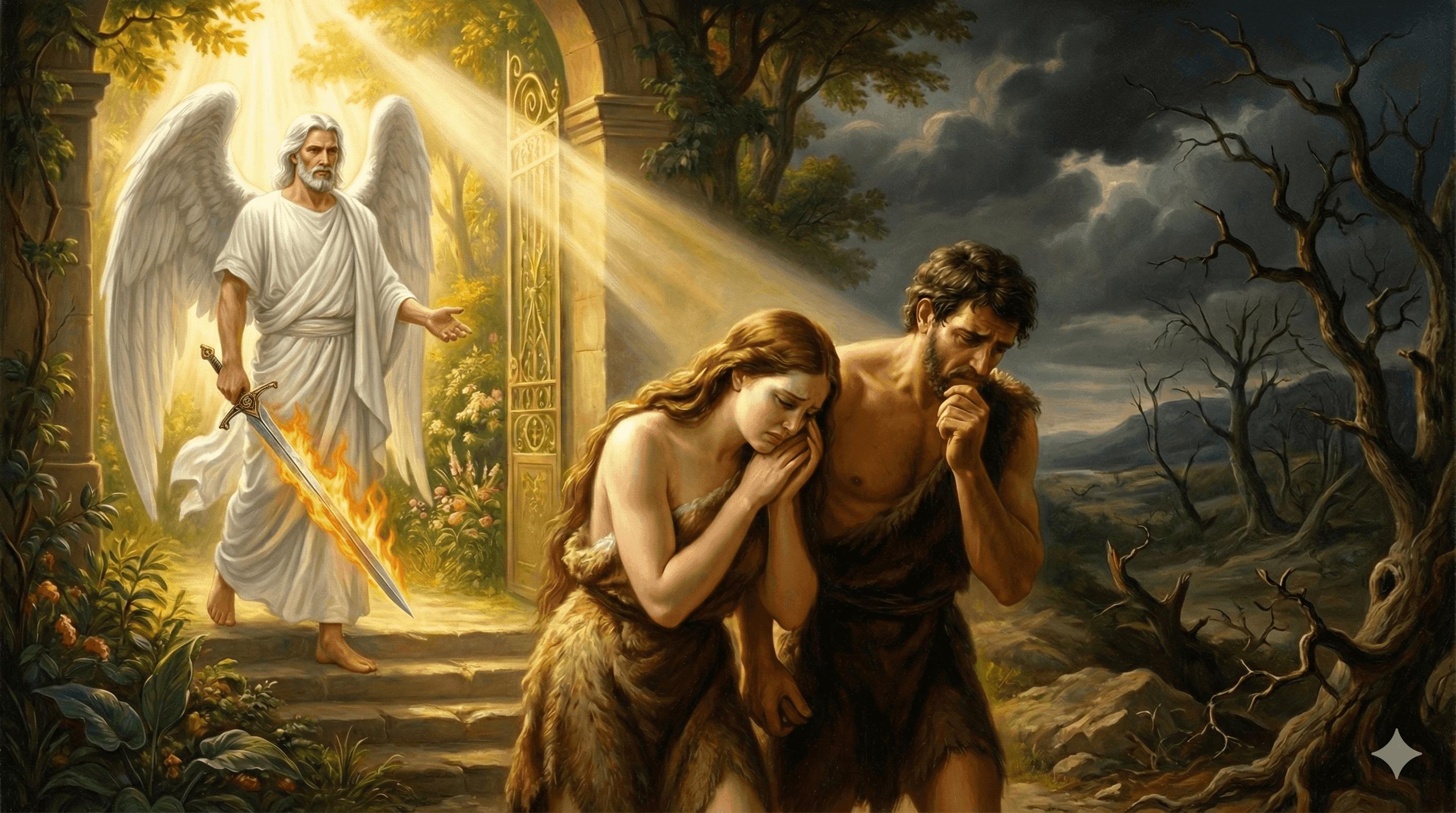
On two separate occasions, the Book of Moses indicates that the Fall of Adam and Eve was a necessary step in the Plan of Salvation. After listening to Adam’s hopeful prophecy of future generations, Eve explained, “Were it not for our transgression we never should have had seed, and never should have known good and evil, and the joy of our redemption” (Moses 5:11).1 According to a report given by Enoch in the next chapter, the Lord declared the following to Adam: “Inasmuch as thy children are conceived in sin, even so when they begin to grow up, sin conceiveth in their hearts, and they taste the bitter, that they may know to prize the good. And it is given unto them to know good from evil” (Moses 6:55–56).
Other Restoration texts convey very similar ideas. “It must needs be that there was an opposition,” taught Lehi, “even the forbidden fruit in opposition to the tree of life; the one being sweet and the other bitter” (2 Nephi 2:15).2 We likewise read the following in D&C 29:39–40: “And it must needs be that the devil should tempt the children of men, or they could not be agents unto themselves; for if they never should have bitter they could not know the sweet—Wherefore, it came to pass that the devil tempted Adam, and he partook of the forbidden fruit and transgressed the commandment.”
These bitter/sweet elements appear to correspond to the evil/good dichotomy inherent in Adam and Eve’s temptation in Eden. They also reflect the sorrow and misery of sin, in contrast to the joy and happiness of eternal life. When read together, these passages indicate that the Fall from Eden was necessary, for without tasting (i.e., experiencing) the bitter/evil/sorrowful aspects of mortal life, mankind could not fully appreciate the sweet/good/joyful aspects of the Plan of Salvation.
Visions of the Bitterness of Death and Hell in Restoration Texts
Since Adam and Eve’s transgression brought sin and death into the world, the bitter element of their fall may help explain the element of bitterness that consistently crops up in visions of hell in Restoration texts. This connection seems to be valid since hell, like the Fall itself, is also intimately associated with sin and death. For instance, during Moses’s encounter with Satan, we read that “Moses began to fear exceedingly; and as he began to fear, he saw the bitterness of hell” (Moses 1:20). Enoch had a similar experience. After witnessing a vision of Satan, the destruction of the flood, and the torment of those imprisoned in hell, Enoch “had bitterness of soul, and wept over his brethren” (Moses 7:44).
This idea also turns up in the Book of Mormon. In each of Alma’s accounts of his remarkable conversion, he commented on his experience with the bitterness of hell:3
- “My soul hath been redeemed from the gall of bitterness and bonds of iniquity” (Mosiah 27:29)4
- “O Jesus, thou Son of God, have mercy on me, who am in the gall of bitterness, and am encircled about by the everlasting chains of death” …. “I say unto you, my son, that there could be nothing so exquisite and so bitter as were my pains. Yea, and again I say unto you, my son, that on the other hand, there can be nothing so exquisite and sweet as was my joy” (Alma 36:18, 21)5
- “And it came to pass that I was three days and three nights in the most bitter pain and anguish of soul” (Alma 38:8)
Alma later applied the “bitter” imagery to all who are in a condition of wickedness and rebellion against God: “behold, an awful death cometh upon the wicked; … they are cast out, and consigned to partake of the fruits of their labors or their works, which have been evil; and they drink the dregs of a bitter cup” (Alma 40:26).6
Christ likewise used the “bitter cup” imagery during his resurrected ministry among the people at Bountiful: “And behold, I am the light and the life of the world; and I have drunk out of that bitter cup which the Father hath given me” (3 Nephi 11:11). He used it again in connection to his atoning sacrifice in D&C 19:18: “Which suffering caused myself, even God, the greatest of all, to tremble because of pain, and to bleed at every pore, and to suffer both body and spirit—and would that I might not drink the bitter cup, and shrink.” This phrasing is significant because the similar statements about Christ drinking a “cup” in the New Testament don’t specifically mention that it was “bitter” (see Matthew 26:39; Mark 14:36; Luke 22:42).
Although scripture never precisely explains how Christ descended “below all things” during his atonement (D&C 88:6), his awareness and perception undoubtedly transcended the garden setting of Gethsemane. His experience with this “bitter cup” thus resonates with the harrowing and “bitter” visions of hell witnessed by Moses and Enoch, and especially with Alma’s own encounter with hell while he was in some type of visionary or out-of-body experience. Due to their similar contexts, the shared element of bitterness in all these visionary accounts of hell does not appear to be a coincidence.
Bitter/Sweet Eden Symbolism in Extrabiblical Sources
Much like the Book of Moses, various extrabiblical sources appear to invoke bitter/sweet imagery in connection to the Fall of Adam and Eve, specifically in the context of them partaking of the forbidden fruit.7 Sometimes these concepts show up together as a pair of opposites, while at other times just one element or the other is mentioned.
1 Enoch
In the book of 1 Enoch, Noah explained that the angel Michael instructed him concerning “all the secret things (found) in the book of my grandfather, Enoch” (1 Enoch 68:1).8 Part of this instruction concerned the secrets revealed to mortals by the fallen angels, one of whom “showed the children of the people all the blows of death, who misled Eve” (1 Enoch 69:6), while another angel “demonstrated to the children of the people the bitter and the sweet and revealed to them all the secrets of their wisdom” (1 Enoch 69:8).9 When read in context, this wisdom clearly relates to the knowledge gained from eating the forbidden fruit.10
2 Enoch and 3 Enoch
Although nothing is said about the bitterness of the trees in Eden in 2 Enoch, the sweetness of the tree of life is alluded to. As part of Enoch’s transformation into an angelic being, he explained that the angel Michael “anointed me and he clothed me. And the appearance of that oil is greater than the greatest light, and its ointment is like sweet dew” (2 Enoch 22:9).11 Based on parallels with Adamic traditions, Andrei Orlov persuasively argues that this ointment most likely derived from the tree of life.12 Similarly, concerning the garden of Eden, we read in the appendix to 3 Enoch that God declared, “Awake, north wind, come, wind from the south. Breathe over my garden, to spread its sweet smell around” (3 Enoch 23:18).13
Cave of Treasures
In the Cave of Treasures, it is reported that Noah and his posterity descended from a holy mountain dwelling associated with the paradise of Eden. In some respects, the account mirrors Adam and Eve’s own bitter expulsion from Eden:
When they went down from the holy mountain, they wept and groaned abundantly because they were driven away from that holy place and habitation of their fathers. They lifted up their eyes toward paradise, wept in great and bitter suffering, wailed in grief, were filled with sadness and said: “Rest in peace, holy paradise, habitation of our father Adam who left you naked and ashamed.” … Thus they went down weeping with great pain and bitter tears.14
Palaea Historica
Concerning the death of Abel, Palaea Historica reports that when Adam witnessed the decaying of his son’s corpse, “he grieved more [because] he too was going to drink from the bitter cup of death.”15 The usage of “bitter cup” may be significant, as this phrase doesn’t occur in the Bible but does turn up in the Book of Mormon and Doctrine and Covenants (as previously noted).
Life of Adam and Eve
A fairly strong parallel with Joseph Smith’s revelations comes from a text known as the Life of Adam and Eve (LAE). In one passage, God explained to Adam, “Because you transgressed my commandment and listened to your wife, cursed is the ground in your labors. … You will grow weary and not rest; be afflicted with bitterness and not taste sweetness” (LAE 24:2).16 Later, when Adam passed away, Eve and “all her children were weeping most bitterly” (LAE 46:2). The angel Michael then explained, “Let [Adam’s deceased body] be in your custody until the day of dispensing punishment at the last years, when I will turn his sorrow into joy” (LAE 47:3).17 When read in context, the implication is that Adam would be resurrected.
This expression of hope in the resurrection relates especially well with Adam and Eve’s statements in Moses 5:10–11: “Blessed be the name of God, for because of my transgression my eyes are opened, and in this life I shall have joy, and again in the flesh I shall see God. And Eve, his wife, heard all these things and was glad, saying: Were it not for our transgression we never should have had seed, and never should have known good and evil, and the joy of our redemption.” Similar sentiments are echoed in 2 Nephi 2:23–25: “And they would have had no children; wherefore they would have remained in a state of innocence, having no joy, for they knew no misery; doing no good, for they knew no sin. … Adam fell that men might be; and men are, that they might have joy.”
Visions of the Bitterness of Hell in Extrabiblical Sources
In addition to the sweet/bitter connection with Adam and Eve’s fall from Eden, several extrabiblical sources depict prophets or other figures viewing or experiencing the bitterness of hell in some type of vision or dream. This mirrors the experiences of Moses, Enoch, Alma, and even Jesus in Restoration sources.
Testament of Abraham
One extrabiblical source that repeatedly features this theme in various contexts is known as the Testament of Abraham (T.Ab). To begin with, Abraham was shown a heavenly judgment scene, with a strait and narrow path leading to a place of rejoicing and a broad and spacious path leading to misery. “And on account of [the strait path] the first-formed Adam rejoices, since he sees the souls being saved. And when he sees many souls entering through the broad gate, then he pulls the hair of his head and casts himself on the ground crying and wailing bitterly” (T.Ab 11:10–11).18
Several chapters later, the Lord sent an angelic being called Death to retrieve Abraham’s soul. “Then the unseen God said to Death, ‘Come, bitter and fierce name of the world, hide your ferocity, cover your decay, and cast off from yourself your bitterness, and put on your youthful beauty and all your glory, and go down to my friend Abraham and take him and conduct him to me” (T.Ab 16:4).19
Also of interest is the fact that the Testament of Abraham repeatedly invokes the phrase “bitter cup,” which once again reflects the distinct phrase found in Joseph Smith’s revelations:20
- “But even to [Abraham] came the common and inexorable bitter cup of death and the unforeseen end of life” (T.Ab 1:3)
- “Then Death said, ‘Most righteous Abraham, behold I tell you the truth. I am the bitter cup of death’” (T.Ab 16:11)
- “And you say, ‘I am the bitter cup of death,’ and do you not rather say ‘I am the best formed of everything good’?” (T.Ab 16:12)
Apocalypse of Sedrach
In the Apocalypse of Sedrach, we read about Sedrach’s heavenly ascent and encounter with God. This account also connects the bitterness of hell closely to the Fall of Adam and Eve:
Sedrach said to [God], “Your discipline is punishment and fire; and they are very bitter, my Lord. … for what reason did you labor with your spotless hands and create man, since you did not desire to have mercy upon him?” God said to him, “I created the first man, Adam .… However, he disobeyed my commandment and having been deceived by the devil he ate from the tree.”21
The Greatness of Moses
The Greatness of Moses describes Moses’s cosmic tour through the heavens and hell (Gehinnom), where he witnessed all sorts of punishments and suffering. At one point, “Gehinnom cried a great and bitter cry, and said to [the angel] Nasargiel: ‘Give to me, as I am hungry!’ He said to it: ‘What shall I give you?’ It said to him: ‘Give me the souls of the righteous.”22 This correlates well with Moses 1:20: “Moses began to fear exceedingly; and as he began to fear, he saw the bitterness of hell.”
Treatise on the Work of Creation
In another source, known as the Treatise on the Work of Creation, the nature of the cosmos is explained directly to the reader (instead of to an initiate undergoing some type of heavenly ascent). Once again, this text associates the realm of hell with bitterness: “The punishments of the wicked are prepared there; difficult and bitter, as it is said, But the wicked will be silenced in darkness.”23
3 Baruch
A particularly notable account comes from the Greek version of 3 Baruch. In the fourth chapter, Baruch explained that the Lord “showed me Hades, and its appearance was gloomy and unclean” (3 Baruch 4:3).24 Baruch then asked, “‘I pray you, show me which is the tree which caused Adam to stray.’ And the angel said, ‘It is the vine which the angel Samael planted by which the Lord God became angered, and he cursed him and his plantling’” (3 Baruch 4:8).25
The angel then explained that when Noah left the ark after the flood, he found an unfamiliar sprig and wondered what it was and whether he should plant it. Noah was particularly concerned that it may produce the same forbidden fruit which had been eaten by Adam and Eve. “And God sent the angel Sarasael, and he said to him, ‘Rise, Noah, plant the sprig, for the Lord says this: ‘Its bitterness will be changed into sweetness and its curse will become a blessing” (3 Baruch 4:15). Based on the context, it is clear that this sprig was viewed as a branch from the tree of knowledge of good and evil. This transformation from bitter to sweet is especially in line with several Restoration passages (Moses 5:11; 6:55; D&C 29:39; 42:46–47).
Islamic Sources
Finally, some Islamic sources give interesting accounts of the prophet Idris (i.e., Enoch) and his encounters with hell and the Angel of Death. It should be remembered that in Moses 6:55, the imagery of taste is associated with the bitterness of sin and death: “when they begin to grow up, sin conceiveth in their hearts, and they taste the bitter, that they may know to prize the good.” This statement, reported by Enoch, is important since the Islamic accounts specifically claim that Enoch tasted death in order to become more righteous and discerning.26 According to one such text,
Then Idris said: “O Angel of Death! I have a request to ask of you.” He answered: “What would that be?” Idrīs said: “Allow me to taste death for a moment during the day. Then I can be informed by it about (its) pain and distress so that I might know the true nature of this (event), and it will spur me in (my) exertion and worship.” The Angel of Death said: “This must be taken up with our Lord.” Then God revealed to him: “Take the soul of My servant for an hour of the day.” So the Angel of Death took the soul of Idrīs for an hour; then he released it and returned it to his body. The Angel of Death then said to him: “What do you think about the chokings of death and its distress?” He answered: “It (the experience) informed me quite a bit about its misery!”27
In another account, Idris made a similar request
Then Idrīs said to him: “I have need of you—I want you to take my soul!” He responded: “Why would you want that? Death entails torment that cannot be measured!” Idrīs said to him: “Perhaps God will bring me back to life after that, and then I could be more attentive in my worship of Him.” Then the Angel of Death said to him: “So what you want, O prophet of God, is to taste death twice! But I have no ability to take your soul unless it is by the command of God Most High, so ask your Lord about this!” Then God Most High revealed (this message) to the Angel of Death: “I know what is in the heart of my servant Idrīs. Therefore take his soul!” So the Angel of Death took his soul. Then God Most High immediately brought him back to life. After this he was meticulous in his devotion so that he fasted and prayed more than (any of) the people, and the Angel of Death treated him as his friend and would come to (visit) him.
Idris then said to the Angel of Death: “Are you able to position me over Jahannam (i.e., Hell) so that I can see into it?” He responded: “Why would you want (to do) that? Jahannam contains horrors which you could not endure, so why should I do that?”28
The important thing here is that Enoch’s tasting of death and his tour of hell ultimately had a salutary effect despite its torment, just as partaking of the forbidden fruit was both a blessing and curse for Adam and Eve, as portrayed in Restoration texts. In addition, these Islamic sources resonate with Enoch’s vision of hell and suffering in Moses 7:24–41.29
Biblical Usage
To be sure, the basic elements in some of these parallels can be found in the Bible. Several biblical texts, for instance, clearly contrast things that are bitter and sweet. Proverbs 27:7 states that “to the hungry soul every bitter thing is sweet.” Likewise, Isaiah 5:20 pronounces a woe upon those who “put bitter for sweet, and sweet for bitter.” What can’t be found, however, are biblical texts that specifically invoke the bitter/sweet dichotomy in the context of Adam and Eve’s fall from Eden, as seen repeatedly in Joseph Smith’s revelations and extrabiblical sources.
A similar situation occurs in regard to bitterness, as it relates to death and hell. Although rare, a few biblical passages associate these elements together. For instance, according to Job 7:9–11, “he that goeth down to the grave shall come up no more. … I will complain in the bitterness of my soul.” Similarly, in Proverbs 4:4–5 we read, “But her end is bitter as wormwood, sharp as a twoedged sword. Her feet go down to death; her steps take hold on hell.” Yet, what can’t be found are biblical texts that invoke these concepts specifically in the context of a vision, cosmic tour, or personal encounter with hell. Thus, once again, Joseph Smith’s revelations and extrabiblical sources have unique contextual parallels that don’t appear to be present in biblical passages.
There are also several other specific parallels between Joseph Smith’s revelations and extrabiblical texts that could be pointed to. For instance, these sources both use the phrase “bitter cup” and also treat the Fall of Adam and Eve as an important step to attaining deeper spiritual understanding and true joy. In contrast, these ideas are either absent or comparatively weak and non-specific in the biblical corpus.30
Conclusion
Within Joseph Smith’s revelations, Adam and Eve’s transgression in Eden is repeatedly conveyed in terms of a bitter/sweet dichotomy. Although this imagery is found in the Book of Mormon and Doctrine and Covenants, it most likely derives from much earlier sacred traditions and texts, as seen in the Book of Moses.31 In connection with this imagery, several of Smith’s revelations utilize the bitter element in the context of visions or personal encounters with death and hell. The subtle and easily overlooked consistency of these elements across a variety of Restoration texts showcases a degree of doctrinal complexity that may be unexpected as coming from Joseph Smith, especially when looking at his limited education and literary background when he produced his earliest revelations.32
At the same time, these same textual features turn up repeatedly in similar contexts in a variety of extrabiblical sources, sometimes altogether or with additional specific parallels thrown into the mix. Since the Bible doesn’t portray these elements in these same settings, it has limited explanatory power as a source of derivation. This article didn’t survey all relevant texts from Jewish, Christian, or Islamic sources, and it is possible that sources were overlooked in Smith’s environment that could have informed him of some of these elements. Overall, however, these textual features resonate very well with ancient and medieval traditions that Smith likely knew little to nothing about.33
Jeff Lindsay and Noel B. Reynolds, “‘Strong Like unto Moses’: The Case for Ancient Roots in the Book of Moses Based on Book of Mormon Usage of Related Content Apparently from the Brass Plates,” Interpreter: A Journal of Latter-day Saint Faith and Scholarship 44 (2021): 1–92
John Tvedtnes, “Tree of Life, Tree of Healing,” Interpreter: A Journal of Latter-day Saint Faith and Scholarship 42 (2021): 171–194, esp. 189.
C. Robert Line, “Bitter and Sweet: Dual Dimensions of the Tree of Life,” in The Things Which My Father Saw: Approaches to Lehi’s Dream and Nephi’s Vision (2011 Sperry Symposium), ed. Daniel L. Belnap, Gaye Strathearn, and Stanley A. Johnson (BYU Religious Studies Center and Deseret Book, 2011), 318–329.
- 1. For more on Adam’s prophecy, see Scripture Central, “Book of Moses Evidence: Adam’s Prophecy,” Evidence 508 (August 20, 2025).
- 2. For an exploration of how these trees may be understood as bitter-sweet opposites, see C. Robert Line, “Bitter and Sweet: Dual Dimensions of the Tree of Life,” in The Things Which My Father Saw: Approaches to Lehi’s Dream and Nephi’s Vision (2011 Sperry Symposium), ed. Daniel L. Belnap, Gaye Strathearn, and Stanley A. Johnson (BYU Religious Studies Center and Deseret Book, 2011), 318–329.
- 3. For more information regarding Alma’s conversion accounts, see Scripture Central, “Book of Mormon Evidence: Alma’s Consistent Conversion Accounts,” Evidence 52 (September 19, 2020).
- 4. It should be noted that although the specific language used here (“gall of bitterness” + “bonds of iniquity”) derives from Acts 8:23 in the New Testament, there are certainly Old Testament passages that evoke similar concepts in close juxtaposition (Exodus 1:14; Jeremiah 2:19–20; Lamentations 3:7; Proverbs 5:4). For more information on why New Testament phrasing turns up regularly in the Book of Mormon, see here.
- 5. This account is particularly relevant, as it not only invokes the bitter imagery but contrasts it with that which is sweet. This aligns with the Eden symbolism mentioned earlier, especially because the language of “taste” is used repeatedly just a few verses later (Alma 36:24–26).
- 6. The verbiage here—involving the imagery of partaking fruit and being cast out—seems, once again, to allude to Adam and Eve’s Fall from Eden (as discussed in the previous section). At the same time, it mirrors the language Alma used to recount the harrowing experience of his own personal encounter with hell.
- 7. It should be clarified that the analysis in this section and the next relies upon English translations and does not directly review the underlying manuscripts in their original languages and in their various recensions. Thus, in some cases, it is possible that the “bitter” or “sweet” idioms are an artifact of the translation and may not reflect the literal wording of the underlying texts. Examples were chosen that seemed to have a greater likelihood of accurately reflecting underlying bitter/sweet language, but further research would be needed for confirmation.
- 8. Translations by E. Isaac, “1 (Ethiopic Apocalypse of) Enoch,” in The Old Testament Pseudepigrapha, 2 vols., ed. James H. Charlesworth (Doubleday, 1983–1985), 47.
- 9. Translations by Isaac, “1 (Ethiopic Apocalypse of) Enoch,” 47–48.
- 10. As clarified just a couple verses later, “Death, which destroys everything, would have not touched them, had it not been through their knowledge by which they shall perish” (1 Enoch 48:11). Translations by Isaac, “1 (Ethiopic Apocalypse of) Enoch,” 1:48. Another potentially relevant account can be seen in 1 Enoch 29–32. We read that Enoch witnessed in vision “the tree of judgment (which has) the smell of rubbish” (1 Enoch 29:1–2). In contrast, he beheld various groves of more pleasant trees. “And I came to the garden of righteousness and saw beyond those trees many (other) large (ones) growing there—their fragrance sweet, large ones, with much elegance, and glorious” (1 Enoch 32:3). Enoch’s angelic guide then explained that one of these trees, called the tree of wisdom, was the very same fruit which Adam and Eve partook of in the Garden of Eden. Translations by Isaac, “1 (Ethiopic Apocalypse of) Enoch,” 27–28.
- 11. Recension J. Translation by F. I. Anderson, “2 (Slavonic Apocalypse of) Enoch,” in The Old Testament Pseudepigrapha, 1:138.
- 12. Andrei A. Orlov, The Enoch-Metatron Tradition (Mohr Siebeck, 2005), 230–231.
- 13. Translation by Philip Alexander, “3 (Hebrew Apocalypse of) Enoch,” in The Old Testament Pseudepigrapha, 1:308. For additional insight into the sweet qualities of the tree of life, see John Tvedtnes, “Tree of Life, Tree of Healing,” Interpreter: A Journal of Latter-day Saint Faith and Scholarship 42 (2021): 171–194, esp. 189.
- 14. Translation by Alexander Toepel, “The Cave of Treasures,” in Old Testament Pseudepigrapha: More Noncanonical Scriptures, 2 vols., ed. Richard Bauckham, James R. Davila, and Alexander Panayotov (Eerdmans, 2013), 1:553. The translation given in E. A. Wallis Budge, The Book of the Cave of Treasure (The Religious Tract Society, 1927), 109 also uses the term “bitter” in this passage as an optional translation term (perhaps due to variants in the manuscripts of this text).
- 15. Translation by William Adler, “Palaea Historica (‘The Old Testament History’),” in Old Testament Pseudepigrapha: More Noncanonical Scriptures, 605.
- 16. M. D. Johnson, “Life of Adam and Eve,” in The Old Testament Pseudepigrapha, 2:283.
- 17. Johnson, “Life of Adam and Eve,” 288–290.
- 18. Translation by E. P. Sanders, “Testament of Abraham,” in The Old Testament Pseudepigrapha, 1:888; italics removed.
- 19. Translation by Sanders, “Testament of Abraham,” 892.
- 20. All translations by Sanders, “Testament of Abraham.”
- 21. Apocalypse of Sedrach 4:1–5. Translation by S. Agourides, “Apocalypse of Sedrach,” in The Old Testament Pseudepigrapha, 1:610. For a comparable discussion with the Lord, see Moses 1:30–31, 39.
- 22. Helen Spurling, “Hebrew Visions of Hell and Paradise,” in Old Testament Pseudepigrapha: More Noncanonical Scriptures, 1:721. Note that the personification of hell as some type of hungry beast or monster is not uncommon in ancient traditions. See, for example, Scripture Central, “Book of Mormon Evidence: Isaiah’s Monster in Jacob’s Teachings,” Evidence 486 (March 19, 2025).
- 23. Spurling, “Hebrew Visions of Hell and Paradise,” 748. See also Scripture Central, “Book of Moses: Hell Was ‘Prepared’,” Evidence 510 (September 3, 2025); Scripture Central, “Book of Moses Evidence: Theme of Darkness,” Evidence 479 (January 31, 2025).
- 24. H. E. Gaylord, Jr., “3 (Greek Apocalypse of) Baruch,” in The Old Testament Pseudepigrapha, 1:667.
- 25. Gaylord, Jr., “3 (Greek Apocalypse of) Baruch,” 667.
- 26. For broader treatments of the “tasting death” metaphor in ancient and medieval sources, see Meredith J. C. Warren, “Tasting Death: Sensory Metaphors and Other Worlds,” CSBS Conference, May 27, 2023; Bruce Chilton, “‘Not to Taste Death:’ A Jewish, Christian, and Gnostic Usage,” in Studia Biblica 1978 (University of Sheffield Press, 1980), 29–36.
- 27. Pseudo-Aṣmaʿī, Nihāyat al-ʿarab fī akhbār al-Furs wa’l-ʿArab (ed. Dānish-Pazhūh); as cited in John C. Reeves and Annette Yoshiko Reed, Enoch from Antiquity to the Middle Ages (Oxford University Press, 2018), 191. For other accounts, see pp. 30, 41, 127, 194,
- 28. Kisā’ī, Qiṣaṣ al-anbiyā’ (ed. Eisenberg); as cited in Reeves and Reed, Enoch from Antiquity to the Middle Ages, 197.
- 29. See Scripture Central, “Book of Moses Evidence: Demonic Laughter and Righteous Weeping,” (forthcoming).
- 30. No biblical passage ever uses the specific phrase “bitter cup.” Romans 5:20 does suggests that the Fall paved the way for Christ’s abundant grace and redemption, but this idea is comparatively muted when contrasted with Restoration texts and extrabiblical sources. One line of evidence for this comes from the fact that most Christian sects have traditionally viewed the Fall in a predominantly negative light.
- 31. For evidence that the Book of Moses likely influenced the contents of the Book of Mormon, see Noel B. Reynolds, “The Brass Plates Version of Genesis,” Interpreter: A Journal of Latter-day Saint Faith and Scholarship 34 (2020): 63–96; Jeff Lindsay and Noel B. Reynolds, “‘Strong Like unto Moses’: The Case for Ancient Roots in the Book of Moses Based on Book of Mormon Usage of Related Content Apparently from the Brass Plates,” Interpreter: A Journal of Latter-day Saint Faith and Scholarship 44 (2021): 1–92; Jeff Lindsay, “Further Evidence from the Book of Mormon for a Book of Moses-Like Text on the Brass Plates,” Interpreter: A Journal of Latter-day Saint Faith and Scholarship 61 (2024): 415–494.
- 32. For exploration of the many complex features within the Book of Mormon itself, see the “Complexity” theme online at scripturecentral.org/evidence. As for Joseph Smith’s education and literary capacity leading up to the translation of the Book of Mormon and Book of Moses, see Scripture Central, “Book of Mormon Evidence: Joseph Smith’s Education,” Evidence 1 (September 19, 2020); Scripture Central, “Book of Mormon Evidence: Comparing Contemporary Authors,” Evidence 106 (November 2, 2020).
- 33. For the most part, the sources highlighted throughout this article would very likely have been inaccessible to Joseph Smith, either because they hadn’t yet been discovered by Western scholars or because they were obscure or unavailable in English translation. The one exception would be 1 Enoch, an English translation of which had been produced by Richard Laurence and published 1821. There is, however, ongoing debate over how likely it is that Smith ever had access to this text or excerpts from it. See Jeffrey M. Bradshaw and Ryan Dahle, “Could Joseph Smith Have Drawn on Ancient Manuscripts When He Translated the Story of Enoch?: Recent Updates on a Persistent Question,” Interpreter: A Journal of Latter-day Saint Faith and Scholarship 33 (2019): 305–374, esp. 308–311; Colby Townsend, “Revisiting Joseph Smith and the Availability of the Book of Enoch,” Dialogue 53, no. 3 (2020): 41–71. Importantly, even if Smith ever did access 1 Enoch, that source would only account for the Eden connection and not for the bitterness in association with visions or encounters with hell.